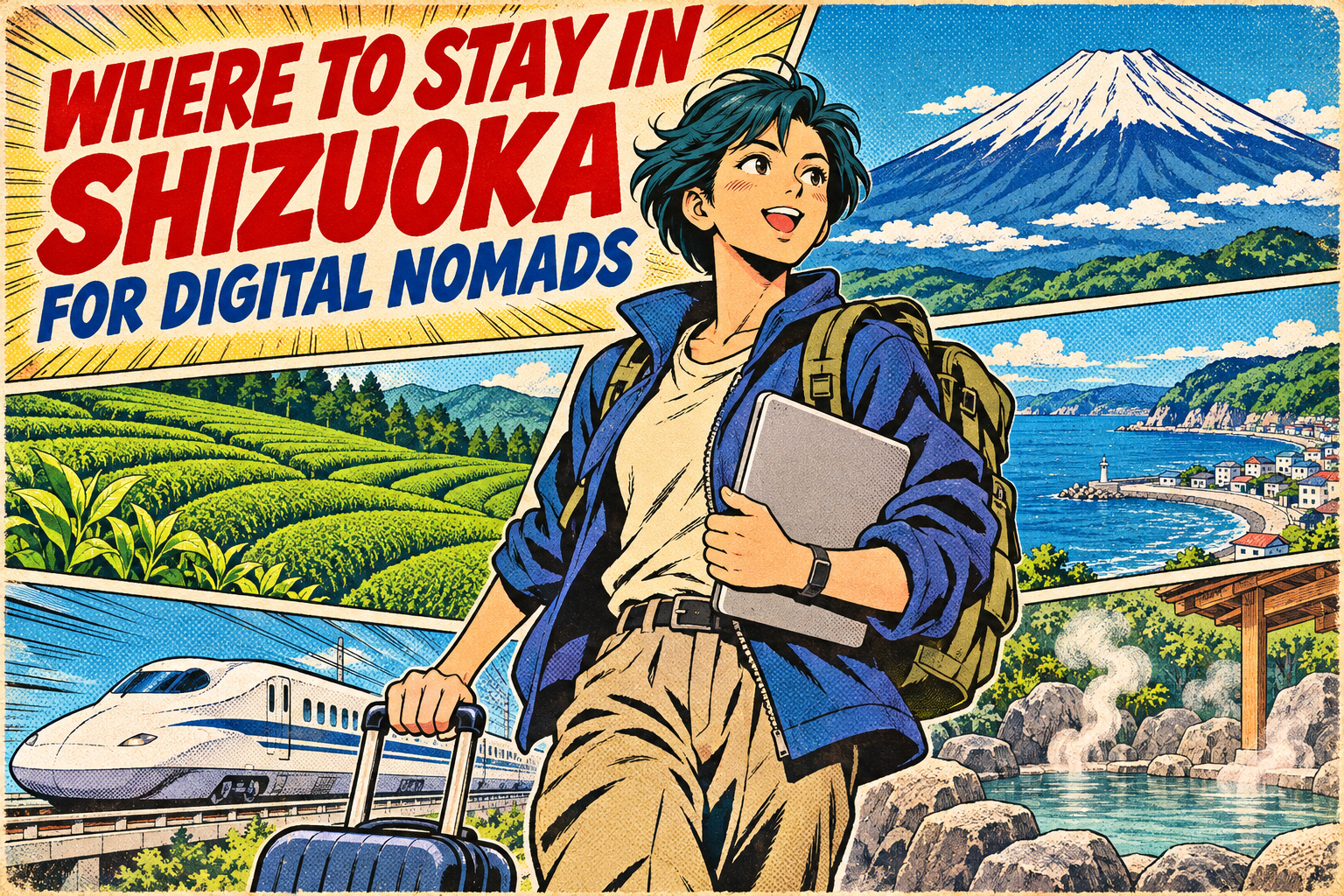

Quick answer: choose Shizuoka Station and Aoi-ku for the best all-round first base, Mishima for frequent Tokyo trips, or Hamamatsu for full-size city infrastructure and western Japan access. Numazu gives you coastal daily life, Fujinomiya puts Mount Fuji at the centre of the stay, Atami combines Tokyo access with an onsen-town rhythm, and Ito or Shimoda works for a slower Izu retreat. Shizuoka is a prefecture, not one compact destination. Choosing the wrong end can add hours—not minutes—to your workweek.
Which Shizuoka base fits your workweek?
Best balanced first base: Shizuoka Station / Aoi-ku — central position, city services and easy rail travel.
Best full-size city alternative: Hamamatsu Station — strong work infrastructure and access toward Nagoya and Osaka.
Best for frequent Tokyo trips: Mishima — direct Shinkansen access and a manageable local centre.
Best coastal daily life: Numazu — port, local services and an Izu gateway, with a conventional-rail connection.
Best Mount Fuji-focused stay: Fujinomiya — slower rhythm and nature access, but no direct Shinkansen station.
Best Tokyo-accessible workation: Atami — rail convenience, onsen character and steep weekend price swings.
Best focused retreat: Ito / Shimoda / the Izu Peninsula — beaches and hot springs with greater transport planning.

Why you can trust this guide
- Research basis: WANDERWORK planning ranges aligned with the Japan city comparison; geography, access and work infrastructure checked against Shizuoka's official tourism bodies, JNTO, municipal access guides and current workspace operators
- Last checked: 2026-11-04
- Before you decide: Monthly ranges are planning anchors for furnished short stays, not ordinary residential rents or listing guarantees. Confirm total price, internet, desk, soundproofing, transport, cancellation terms, severe-weather procedures and legal stay requirements for your dates.
This guide answers one decision: which Shizuoka base should a remote worker choose? It does not pretend that Shizuoka City, Mount Fuji and southern Izu are neighbourhoods of the same town. The prefecture stretches along the Tokaido corridor between Tokyo and Nagoya, then reaches south through the Izu Peninsula. A base that is excellent for Tokyo meetings can be poor for a beach retreat, and the reverse is equally true.
If you are still comparing destinations, start with the best cities in Japan for digital nomads. Use roughly ¥180,000–¥330,000 per month as a comfortable solo planning band for accommodation, food, local transport, workspace and normal extras, then rebuild it with the Japan cost-of-living guide. Check the Japan digital nomad visa guide before assuming your planned work is permitted.
\ Choose the rail-and-work zone before the room /
Rates, taxes and cancellation rules are shown on Agoda at checkout.
Best choice by situation
| Your situation | Start with | Why |
|---|---|---|
| First Shizuoka stay | Shizuoka Station / Aoi-ku | Central, practical and easiest to understand |
| Frequent Tokyo meetings | Mishima or Atami | Direct rail access with different city rhythms |
| Frequent Nagoya or Osaka trips | Hamamatsu | Western position on the Tokaido corridor |
| Call-heavy workweek | Shizuoka City, Hamamatsu or Mishima | Deeper workspace and hotel inventory |
| Mount Fuji is the priority | Fujinomiya | Best local access to the western Fuji area |
| Coast without a full retreat | Numazu | Everyday city services plus Suruga Bay |
| Onsen and deep-focus stay | Atami, Ito or Shimoda | Retreat value, with season and transport trade-offs |
Choose one operational candidate and one lifestyle candidate. “Near Mount Fuji” is not a usable location filter by itself; the mountain spans multiple access corridors, and a postcard view does not guarantee a desk, reliable Wi-Fi or an easy grocery run.
Shizuoka geography in two minutes: east, central, west and Izu
The Tokaido Shinkansen is the prefecture's operating spine. From east to west, the main Shinkansen stations are Atami, Mishima, Shin-Fuji, Shizuoka, Kakegawa and Hamamatsu. Not every train stops at every station, so the fastest-looking base on a map may still require a timetable check.
Think in four zones:
- East: Mishima, Numazu and the Fuji area—best connected to Tokyo and useful for northern Izu.
- Central: Shizuoka City—best balanced for city services and a central position inside the prefecture.
- West: Hamamatsu—stronger for Nagoya and Osaka, with a larger independent city economy.
- Izu: Atami, Ito, Shimoda and inland/coastal resort towns—best for retreat value, but transport becomes slower away from the rail corridor.
One detail prevents expensive mistakes: Shin-Fuji Station and Fuji Station are separate stations without a direct rail interchange. Shin-Fuji serves the Shinkansen; Fuji serves conventional JR lines including the connection toward Fujinomiya. Check the transfer route before booking around either name.
Mount Fuji Shizuoka Airport can be useful for selected domestic and regional routes, but it is not the default gateway for every Shizuoka base. The official Hello Navi access guide shows separate routes to Shizuoka and Hamamatsu. For many international arrivals, the Tokaido rail corridor from Tokyo, Shinagawa or Nagoya is simpler.
The 7 best Shizuoka bases for digital nomads at a glance
These are furnished solo-stay planning anchors, not market averages. Season, weekends, festivals, room size, utilities, cleaning, desk quality and cancellation flexibility can change the total substantially.
| Base | Best for | Rough monthly (JPY) | Car need | Work infrastructure |
|---|---|---|---|---|
| Shizuoka Station / Aoi-ku | First stay and balanced city life | ¥120,000–¥260,000+ | Low in core | Strong |
| Hamamatsu Station | City infrastructure and western access | ¥110,000–¥240,000+ | Low in core; higher outside | Strong |
| Mishima | Tokyo-linked hybrid work | ¥120,000–¥260,000+ | Low in core | Medium–strong |
| Numazu | Coastal daily life and Izu gateway | ¥90,000–¥210,000 | Low–medium | Medium |
| Fujinomiya | Mount Fuji and slow living | ¥80,000–¥190,000 | Medium–high | Light–medium |
| Atami | Tokyo-accessible onsen workation | ¥140,000–¥320,000+ | Low near rail; hills matter | Medium |
| Ito / Shimoda / Izu | Beach, onsen and focused retreat | ¥100,000–¥280,000+ | Medium–high | Stay-dependent |
Price the whole operating system. A cheaper room can lose through car rental, taxis, coworking, poor ergonomics or a two-hour round trip every time you need a reliable meeting room.
1. Shizuoka Station and Aoi-ku — best balanced first base
Shizuoka City is the safest first recommendation because it balances rail access, city services and a central position inside the prefecture. Stay near Shizuoka Station, Shin-Shizuoka or the walkable Aoi-ku centre if you want groceries, restaurants, workspaces and regional transport without a car.
Why it works
- Tokaido Shinkansen and conventional JR access
- Broad hotel, furnished-stay and everyday-service inventory
- Central position for day trips east or west
- Current drop-in options near the station, including LINK and other facilities in the prefecture's workspace directory
Trade-offs
- It is not the best base for southern Izu or repeated Tokyo meetings
- Shinkansen stopping patterns matter
- Station hotels can have narrow desks despite business branding
- A Mount Fuji view is weather-dependent and not the city's main operational advantage
Best for first-time visitors, mixed work-and-travel months and anyone who wants a real city routine before adding rural side trips. Keep the home-to-station walk short; buses are useful, but a rail-first base is easier to repeat.
2. Hamamatsu Station — best full-size city and western access
Hamamatsu sits roughly halfway between Tokyo and Osaka. The official visitor guide places Tokyo and Shin-Osaka at about 90 minutes by Hikari and Shizuoka at about 25 minutes by Kodama, subject to the train selected. The centre around Hamamatsu Station and Dai-Ichi-dori gives you the most practical car-free version of western Shizuoka.
Why it works
- Strong access toward Nagoya, Kyoto and Osaka
- Large-city supermarkets, restaurants, healthcare and accommodation
- Established workspaces such as Dexi, including a station-area location
- More room to build a local routine than in a resort town
Trade-offs
- Tokyo is possible but not the efficient choice for frequent same-day meetings
- Outside the central rail and Entetsu corridor, car dependence increases
- Wind and summer heat can affect walking comfort
- The city is spread out; “Hamamatsu” does not automatically mean station convenience
Best for longer projects, western Japan clients and remote workers who want ordinary city infrastructure rather than a tourism-first environment.
3. Mishima — best for Tokyo-linked hybrid work
Mishima is the strongest hybrid answer. Its official access guide puts Tokyo at roughly 45 minutes by Shinkansen and Shinagawa at around 37 minutes on suitable services. The station area is compact, and the city centre extends toward Mishima Taisha with water, restaurants and local workspaces.
Why it works
- Direct Shinkansen access to Tokyo and Shinagawa
- Easier base for northern Izu and eastern Shizuoka
- Walkable central corridor if you choose the station side carefully
- Work infrastructure around facilities such as Work:well Mishima and LtG-related spaces
Trade-offs
- Less nightlife and accommodation depth than Shizuoka City
- Fast trains and room supply can price up around peak dates
- Southern Izu still takes time
- A quiet residential listing can be inconvenient for daily station use
Best for people with a Tokyo client day every week or two. It is not “Tokyo at Shizuoka prices” by default; calculate the rail fare and booking flexibility before treating the commute as routine.
4. Numazu — best coastal daily life
Numazu offers a more local coastal routine around Suruga Bay while retaining conventional JR access. The station area supports normal daily life, and the port adds seafood and waterfront character. It also works as a gateway toward western Izu, although the final transport step depends on the destination.
Why it works
- Coastal identity without committing to a resort town
- Everyday shopping and services around the station
- Access to Mishima by conventional rail for Shinkansen connections
- Potentially broader value scan than Mishima or Atami
Trade-offs
- No Shinkansen stop at Numazu Station
- Coworking and English-first support are thinner than in larger hubs
- Coastal and low-lying locations require hazard-map awareness
- Izu trips can still need buses, transfers or a car
Best for a slower month with occasional Tokyo travel rather than frequent early meetings. Choose station convenience first and visit the port; do not automatically sleep beside the attraction.
5. Fujinomiya — best Mount Fuji-focused slow stay
Fujinomiya is the clearest choice when the western side of Mount Fuji is the reason for the trip. It provides access toward Shiraito Falls and the Asagiri area, while the city itself offers a quieter local rhythm than the main Shinkansen hubs.
Why it works
- Strongest thematic fit for a Fuji-centred stay
- Lower-cost accommodation scan than major rail hubs
- Local food, neighbourhood routine and nature access
- Suitable for creative projects where outdoor time is part of the plan
Trade-offs
- Fujinomiya is not on the Shinkansen
- Access from Shin-Fuji or Fuji requires a bus, taxi or conventional-rail connection
- A car becomes useful for dispersed nature destinations
- Workspace inventory and late-night services are limited
Best for writers, photographers and remote workers who can protect focus days. It is a weak choice for repeated Tokyo meetings or daily coworking variety.
6. Atami — best Tokyo-accessible onsen workation
Atami combines a Shinkansen stop, Tokyo access, hot springs and a compact visitor economy. It is the easiest Shizuoka retreat to add to a Tokyo-facing work schedule, which is also why weekends and holiday periods can feel completely different from weekdays.
Why it works
- Direct rail access from Tokyo and eastern Japan
- Hotels, restaurants and onsen infrastructure
- Coworking options such as naedoco
- Easy short-stay test before committing to a longer Izu base
Trade-offs
- Weekend and holiday accommodation prices can jump sharply
- Hills make straight-line map distances misleading
- Tourist blocks can be crowded and noisy
- Some ryokan rooms are excellent for rest and terrible for eight-hour laptop days
Best for a workation that deliberately separates work blocks from recovery. Book weekdays where possible, ask about desk and call conditions, and trace the uphill route from the station before paying.
7. Ito, Shimoda and the Izu Peninsula — best focused retreat
Izu is the lifestyle choice: beaches, hot springs, diving, hiking and smaller towns. JNTO identifies Atami, Ito and Shimoda as major rail-side hubs, but the peninsula becomes slower and more car-dependent away from those corridors. Treat “Izu” as a region, not a neighbourhood.
Why it works
- Strong nature and recovery value
- Good fit for writing, design and deep-focus sprints
- Rail access to Ito and Shimoda, with buses serving selected areas
- Wide choice of hotels, guesthouses and longer-stay properties
Trade-offs
- Transport time increases quickly beyond the main stations
- Workspace quality depends heavily on the accommodation
- Seasonal demand, typhoons and road disruption can affect plans
- Social and professional networks are thinner outside the hubs
Best for experienced remote workers with backup connectivity and a controlled calendar. For a first test, stay near Ito or Izukyu-Shimoda Station rather than an isolated villa selected only for the view.
Where should you avoid staying in Shizuoka?
Avoid an address that creates the same operational problem every day.
- A remote resort without a car plan: the room can be cheap while every meal and meeting becomes expensive.
- A “Mount Fuji” listing with vague transport: verify the station, municipality and actual route.
- An Atami hillside room chosen by map distance: elevation can turn a short line into a difficult luggage trip.
- A Shin-Fuji/Fuji booking made as if the stations connect: plan the transfer explicitly.
- A ryokan without desk or call permission: hospitality quality and work suitability are different tests.
- A coastal stay without backup plans: review local hazard maps, evacuation information and cancellation terms.
This is not an argument against rural Shizuoka. It is an argument for matching the base to the workweek instead of buying scenery first and logistics later.
Cheapest practical Shizuoka bases for a remote worker
Start the value scan in Numazu, Fujinomiya and residential Hamamatsu, then compare the total against Shizuoka City. The headline room price is only one component. Add workspace fees, car or taxi cost, laundry, utilities, cleaning and the value of time lost to transfers.
For stays of a month or longer, ask for the all-in price in writing. Some listings display a low nightly or monthly rate before service fees, utilities or cleaning. If the room has no ergonomic chair, include a coworking budget instead of pretending the kitchen table is free.
Atami and Izu can also produce good weekday or off-season value, but the price curve is volatile. Search flexible dates and compare Sunday-to-Friday patterns before assuming a monthly figure from one weekend result.
Shizuoka City or Mishima for a first stay?
| Choose Shizuoka City if… | Choose Mishima if… |
|---|---|
| You want the best all-round city base | You need the easiest Tokyo-facing schedule |
| You plan trips in both directions | You will focus on eastern Shizuoka and northern Izu |
| You want deeper everyday and workspace choice | You prefer a smaller, more manageable centre |
| Your workweek is mostly local or online | You expect occasional in-person Tokyo meetings |
| You want fewer reasons to rent a car | You accept rail costs as part of the operating budget |
For most first-time digital nomads, Shizuoka City is the safer default. Mishima wins when Tokyo access is not a vague benefit but a repeated requirement.
Where to stay in Shizuoka without a car
Choose Shizuoka Station, central Hamamatsu, Mishima Station, Atami Station, central Numazu, Ito Station or Izukyu-Shimoda Station. Then test three repeated routes: accommodation to groceries, accommodation to a call-ready workspace and accommodation to the intercity station.
A car-free stay is possible in each of those hubs, but it does not mean the whole prefecture becomes car-free. Fujinomiya's outer attractions, rural Fuji areas, inland Izu and many beaches are easier by car or require careful bus planning. If you cannot legally drive in Japan, solve that before booking a remote property—not after arrival.
Airport and Shinkansen access: name the station before the city
For Tokyo-facing arrivals, Mishima and Atami reduce rail time. For central Shizuoka, Shizuoka Station is the cleanest reference point. For western Shizuoka and Nagoya-facing travel, Hamamatsu is stronger.
Do not write “near Shizuoka” in the itinerary. Write the exact station and the exact train. A Kodama, Hikari and Nozomi do not share the same stopping pattern. Add a buffer for luggage and ticket changes, and check the last connection when continuing to Fujinomiya, Numazu or southern Izu.
Mount Fuji Shizuoka Airport is useful only when the route fits. Airport buses and local transfers should be compared with a rail journey from a major international gateway. A regional airport is not automatically the fastest option for a prefecture this long.
Coworking, calls and internet backup
Shizuoka City and Hamamatsu provide the deepest workspace choice. Mishima and Atami have credible local options; Numazu, Fujinomiya and southern Izu require more accommodation-led planning.
Before booking, request:
- A current Wi-Fi speed test from the exact room, not the lobby.
- Confirmation that calls are allowed and the likely quiet hours.
- A desk photo showing chair, outlet and lighting.
- Mobile coverage for your backup carrier or eSIM.
- The nearest bookable booth or meeting room.
Run the first important client call from a workspace or tested private room. A café is a backup for light tasks, not a confidentiality plan.
Earthquakes, typhoons, heat and business continuity
Shizuoka's attraction—coast, mountains and a long transport corridor—also creates different disruption risks by location. Earthquakes, tsunami exposure in selected coastal zones, typhoons, heavy rain, landslides, summer heat and rail suspensions should be treated as business-continuity variables, not travel trivia.
This does not make Shizuoka unsuitable. It makes preparation non-negotiable:
- Check the municipality's hazard map for the exact address.
- Save the accommodation's evacuation route offline.
- Keep a power bank, mobile data backup and one flexible workday.
- Avoid scheduling an irreplaceable call immediately after a long rural transfer.
- Read transport alerts before moving between Izu and the Tokaido corridor.
Booking checklist for a Shizuoka remote-work stay
- [ ] Exact station, municipality and walking route confirmed
- [ ] Total price includes taxes, cleaning, utilities and required fees
- [ ] Desk, chair, outlets and room lighting verified
- [ ] Room-level Wi-Fi evidence received
- [ ] Call rules and quiet hours confirmed
- [ ] Grocery, laundry and workspace routes tested on the map
- [ ] Car need and legal driving documents resolved
- [ ] Shinkansen stopping pattern and final local connection checked
- [ ] Hazard map and evacuation route reviewed
- [ ] Flexible cancellation retained until the work setup is credible
\ Book the operating base, not just the view /
Check the final price, cancellation terms, desk and room-level Wi-Fi before payment.
Frequently asked questions
Is Shizuoka good for digital nomads?
Yes, if you want a quieter alternative to Tokyo or Osaka and choose the correct transport corridor. Shizuoka City, Hamamatsu and Mishima provide the easiest operating bases; Izu and Fujinomiya are stronger for retreat value than frequent meetings.
Is Shizuoka City or Hamamatsu better for remote work?
Choose Shizuoka City for the best central position within the prefecture. Choose Hamamatsu for a larger western base and easier access toward Nagoya and Osaka. Both work without a car when you stay near the central station.
Where should I stay in Shizuoka to see Mount Fuji?
Fujinomiya is the strongest base for the western Fuji area. Mishima and the eastern side can also provide access and views, but visibility depends on weather. Select the transport route and work setup before paying a premium for a promised view.
Can I stay in Shizuoka without a car?
Yes in Shizuoka City, central Hamamatsu, Mishima, Numazu, Atami, Ito and central Shimoda. A car becomes more useful for rural Fuji destinations, inland Izu and dispersed beaches. Check the exact accommodation-to-station route.
Is Atami suitable for a month-long workation?
It can be, especially for Tokyo access and recovery time. Compare weekday and weekend pricing, verify the hill, and confirm that the room supports calls and long laptop sessions. An onsen hotel is not automatically a work-ready monthly base.
Is Mount Fuji Shizuoka Airport the best airport for Shizuoka?
Not always. It depends on the flight and final base. Compare the complete airport-bus journey with rail from Tokyo, Shinagawa or Nagoya. For Mishima, Atami and much of Izu, a Tokyo-area gateway may be more practical.
How long should a digital nomad stay in Shizuoka?
Two to four weeks is enough to test one base and make selected day trips. Do not try to “cover Shizuoka” from one room. For a longer stay, split the month between an operational hub such as Shizuoka City or Mishima and a retreat base such as Izu.
Final recommendation
Choose Shizuoka Station / Aoi-ku for the strongest first base. Choose Mishima when Tokyo meetings are a real calendar requirement, and Hamamatsu when western Japan access and city infrastructure matter more. Pick Numazu or Fujinomiya for a slower local routine, and use Atami or Izu for a deliberate retreat—not as a vague substitute for the whole prefecture.
The winning Shizuoka booking is not the room with the best mountain or ocean photo. It is the base that keeps calls, groceries, transport and recovery boringly reliable. In remote work, boring logistics are a luxury product.



 Quick answer: choose Shizuoka Stat)