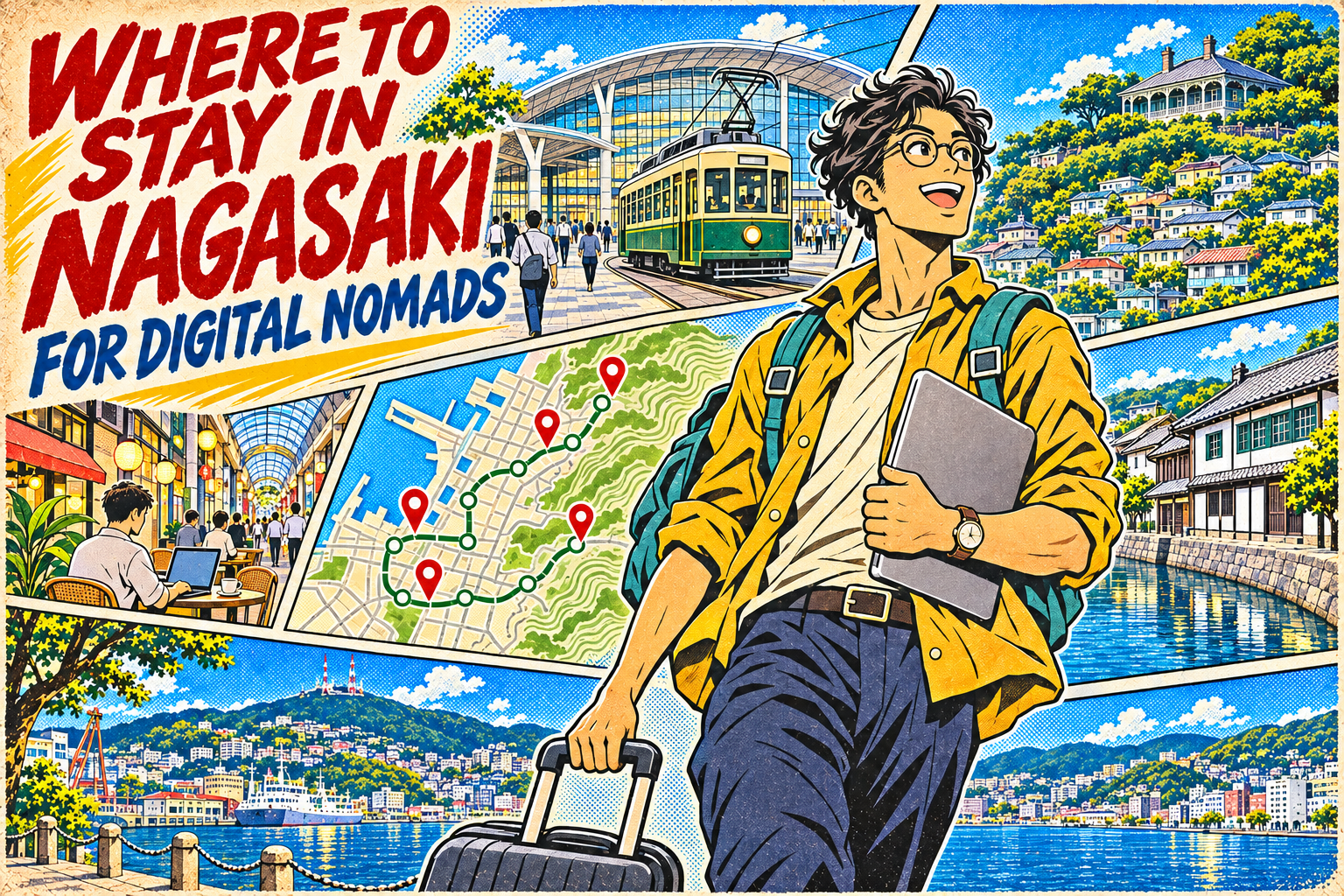

Quick answer: choose Nagasaki Station for the easiest arrival and regional travel, or Hamanomachi and Shinchi for the best walkable daily-life base. Dejima and Ohato balance waterfront calm with central access; Oura offers character but more slopes; Urakami works for a quieter practical stay; Sumiyoshi stretches the budget; and Iojima is a retreat, not a convenient city base. In Nagasaki, the wrong side of a hill can matter more than the straight-line distance on a map.
Which Nagasaki area fits your workweek?
Easiest arrival and rail travel: Nagasaki Station / Stadium City — Shinkansen, airport buses and modern services.
Best overall daily-life balance: Hamanomachi / Shinchi / Shianbashi — shopping, food, trams and central walkability.
Best waterfront work rhythm: Dejima / Ohato — central, flatter and close to creative work facilities.
Best historic atmosphere: Oura / Minamiyamate — port views and heritage, with slope and grocery trade-offs.
Best calm practical base: Urakami / Peace Park — transport, everyday services and quieter evenings.
Best value and local routine: Sumiyoshi / Chitose-machi — residential services and tram access north of the centre.
Best focused retreat: Iojima — coast and resort infrastructure, but weak for spontaneous city meetings.

Why you can trust this guide
- Research basis: WANDERWORK planning ranges aligned with the Japan city comparison; district and transport positioning checked against Nagasaki's official visitor guidance, Nagasaki Airport, Nagasaki Electric Tramway, Nagasaki Stadium City and current coworking operators
- Last checked: 2026-11-04
- Before you decide: Monthly ranges are planning anchors for furnished short stays, not ordinary residential rents or listing guarantees. Confirm total price, internet, desk, soundproofing, slope access, cancellation terms, seasonal conditions and legal stay requirements for your dates.
This guide answers one decision: where should a remote worker stay in Nagasaki City? It does not rank sightseeing stops or explain how to join a government-backed residency. The comparison starts with a repeatable workweek—sleep, calls, tram access, groceries, airport friction and hills—then treats heritage and harbour views as benefits.
The separate Nagasaki Nomad Residency 2026 guide tracks that named program. This article is for a self-funded stay that you can arrange independently.
If you are still comparing cities, start with the best cities in Japan for digital nomads. Use roughly ¥180,000–¥300,000 per month as a comfortable solo planning band for accommodation, food, local transport, workspace and normal extras, then rebuild it with the Japan cost-of-living guide. Check the Japan digital nomad visa guide before assuming your planned work is permitted.
\ Choose the tram-and-work zone before the room /
Rates, taxes and cancellation rules are shown on Agoda at checkout.
Best choice by situation
| Your situation | Start with | Why |
|---|---|---|
| First Nagasaki stay | Nagasaki Station or Hamanomachi | Simple orientation and broad services |
| Call-heavy workweek | Dejima, Urakami or Sumiyoshi | Calmer evenings and practical work routes |
| Frequent rail trips | Nagasaki Station | Direct access to JR and the West Kyushu Shinkansen |
| Frequent airport trips | Station, Ohato or Shinchi | Airport-bus stops without a final hill climb |
| Coworking and creative network | Station or Dejima | Current operators and central meeting access |
| Lower-cost local routine | Sumiyoshi or Urakami | Wider residential scan on tram and bus routes |
| Retreat with ocean access | Iojima | Focus and resort facilities, away from city convenience |
Choose one operational candidate and one lifestyle candidate. A scenic room is not a bargain if every grocery run, airport transfer or client call begins with a steep climb.
Nagasaki geography in two minutes: follow the tram, then check the hill
Nagasaki's centre is compact, but it is not flat. The official visitor guide describes an urban area that extends up surrounding hillsides. That creates the core booking rule: measure the route to the nearest tram stop or useful bus stop, not the map distance to an attraction.
The tram links Nagasaki Station, Stadium City, Urakami, Peace Park, Dejima, Ohato, Shinchi Chinatown, Hamanomachi, Shianbashi, Oura and Sumiyoshi-area stops. It is the easiest spine for a car-free workweek. Transfers and service patterns can change, so check the current Nagasaki Electric Tramway map rather than memorising an old route diagram.
Nagasaki Airport is outside the city. The official airport guide lists limousine-bus routes through Nagasaki Station and Shinchi; the fastest headline journey to the station is roughly 43 minutes, but road conditions can add time. This is not Fukuoka: there is no five-minute airport subway.
The 7 best Nagasaki areas for digital nomads at a glance
These are furnished solo-stay planning anchors, not market averages. Season, festivals, room size, utilities, cleaning, Wi-Fi evidence and cancellation flexibility can change the total substantially.
| Area | Best for | Rough monthly (JPY) | Hills | Work infrastructure |
|---|---|---|---|---|
| Nagasaki Station / Stadium City | Arrival, rail and first-time convenience | ¥130,000–¥280,000+ | Low near main route | Strong |
| Dejima / Ohato | Waterfront, central access and creative work | ¥120,000–¥260,000+ | Low–medium | Strong |
| Hamanomachi / Shinchi / Shianbashi | Walkability, food and daily life | ¥110,000–¥240,000 | Low in core | Medium–strong |
| Oura / Minamiyamate | Historic atmosphere and port views | ¥100,000–¥230,000 | Medium–high | Medium |
| Urakami / Peace Park | Calm routine and practical transport | ¥90,000–¥210,000 | Low–medium | Medium |
| Sumiyoshi / Chitose-machi | Value and residential services | ¥80,000–¥190,000 | Low near tram | Medium |
| Iojima | Coastal retreat and focused projects | ¥160,000–¥350,000+ | Low on resort route | Stay-dependent |
Price the whole operating system. A cheaper hillside room can lose through taxis, time, poor desk ergonomics and the daily friction of carrying groceries uphill.
1. Nagasaki Station and Stadium City — best for arrival and rail travel
The station zone is the operational answer. Nagasaki Station handles JR and the West Kyushu Shinkansen, airport buses stop nearby, and the redeveloped waterfront side provides hotels, retail and restaurants. Stadium City is roughly a ten-minute walk from the station according to its official access guide and adds events, shops and services north of the rail hub.
Why it works
- Easiest arrival with luggage
- Best base for rail trips and early departures
- Airport-bus and tram access
- Coworking Space Minato publishes drop-in and monthly options about a seven-minute walk from the station
Trade-offs
- It feels more functional than atmospheric
- Event days can change crowd and noise levels around Stadium City
- Station hotels may have small desks despite business positioning
- Hamanomachi and Shianbashi are a tram ride rather than outside the door
Best for first-time visitors, short projects and anyone moving onward by rail. Check the room's desk depth and chair rather than assuming a new building is automatically work-ready.
2. Dejima and Ohato — best waterfront work rhythm
Dejima and Ohato sit between the station and central shopping districts. The area is comparatively flat along the port, connected by tram and airport bus, and close enough to Hamanomachi for food without sleeping in its busiest nightlife blocks.
Why it works
- Central position between station and downtown
- Waterfront walks and easier luggage movement
- Direct access to Dejima, Ohato and nearby tram stops
- DEJIMA MEDIA CENTER lists creative facilities and the attached AGORA coworking space
Trade-offs
- Waterfront and event-facing rooms can carry a premium
- Office or tourist blocks may feel quiet late at night
- A harbour view says nothing about Wi-Fi or soundproofing
- Convenience varies sharply between the port edge and inland streets
Best for creators, client meetings and remote workers who want a calm visual environment without leaving the central corridor.
3. Hamanomachi, Shinchi and Shianbashi — best overall daily-life base
The official guide describes the Hamanomachi arcade area as central Nagasaki's most active downtown district, where shopping and daily life mix. Shinchi adds Chinatown, tram and airport-bus access; Shianbashi brings restaurants and nightlife.
Why it works
- Strongest walkable mix of food, shopping and everyday services
- Multiple tram stops and easy access east or west
- Airport-bus convenience around Shinchi
- Broadest central evening choice
Trade-offs
- Shianbashi and entertainment streets can be noisy late
- Festival periods change crowds and room prices
- Older buildings need careful checks for insulation and lifts
- A central address can still sit on an uphill side street
Best for a first month when you value daily convenience more than a station lobby. For client calls, stay closer to Shinchi or the arcade edge than the loudest Shianbashi blocks.
4. Oura and Minamiyamate — best historic atmosphere
Oura and Minamiyamate place Glover Garden, the former foreign settlement and port views within the daily landscape. The area has tram access along the lower corridor, but many attractive streets rise quickly above it.
Why it works
- Distinctive historic setting rather than generic city living
- Port access and scenic walking
- Tram route through the lower Oura corridor
- Calmer evenings away from central nightlife
Trade-offs
- Slopes and stairs can become a daily tax
- Grocery and late-night choice is thinner than Hamanomachi
- Heritage-style accommodation may compromise desk, lift or insulation
- Airport travel often needs a connection to a central bus stop
Best for photographers, writers and slower stays where atmosphere is part of the work. Ask for the exact walking route from the tram stop before paying for a view.
5. Urakami and Peace Park — best calm practical base
Urakami sits north of the central station zone with JR, tram and bus access. Peace Park and the Atomic Bomb Museum define the visitor map, but the practical advantage is a calmer urban routine with supermarkets, hospitals and transport still close.
Why it works
- Useful tram, bus and JR options
- Quieter evenings than the central entertainment district
- Airport-bus routing via Peace Park and nearby northern stops
- Practical everyday services for a longer stay
Trade-offs
- Less restaurant and coworking density than downtown
- Some addresses climb away from the main transport corridor
- Social meetings often require a ride into the centre
- The area requires respectful behaviour around memorial sites
Best for focused work, longer stays and remote workers who need a dependable routine more than nightlife.
6. Sumiyoshi and Chitose-machi — best value and local routine
Sumiyoshi and Chitose-machi extend the tram corridor north through residential and university-oriented services. This is where the accommodation scan can become cheaper without giving up public transport entirely.
Why it works
- Tram access to Urakami, the station and downtown
- Local groceries, restaurants and everyday services
- Wider residential price scan
- Better fit for home-based work than a tourist-first address
Trade-offs
- Longer ride to Dejima, Hamanomachi and Oura
- Less English-first service than major visitor zones
- Coworking choice is thinner
- A cheap listing far from the tram can erase the value
Best for budget-conscious remote workers staying several weeks or longer. Keep the home-to-tram walk short and verify broadband rather than relying on neighbourhood reputation.
7. Iojima — best focused coastal retreat
Iojima is part of Nagasaki City but operates as a retreat rather than an urban neighbourhood. Official tourism guidance places it roughly 50 minutes from Nagasaki Station by bus. Resort facilities and the coast can support a focused workation, but daily city access is the cost.
Why it works
- Ocean access and a clear break from city routines
- Resort-style facilities in selected stays
- Strong fit for writing, recovery or a defined project sprint
- Possible no-car access when bus timing fits
Trade-offs
- Weak for spontaneous meetings and nightlife
- Workspace quality depends almost entirely on the property
- Food and service choice is limited compared with central Nagasaki
- Weather or transport disruption has greater impact
Best as a second-stage retreat after you understand the city, not as the default first Nagasaki base.
Where should you avoid staying in Nagasaki?
Avoid treating these as automatic bargains:
- A hillside property with no verified access route. A short map distance can hide stairs and steep roads.
- The loudest Shianbashi blocks for call-heavy work. Central convenience does not cancel late-night noise.
- A remote scenic stay without a desk or backup connection. Views do not complete video calls.
- Iojima for a meeting-heavy week. The commute removes the retreat advantage.
- A station hotel chosen only by brand. Confirm desk depth, chair, Wi-Fi evidence, laundry and total price.
Cheapest practical Nagasaki areas for a remote worker
Start with Sumiyoshi and Chitose-machi, then compare Urakami. They can widen the residential scan while retaining tram or rail access. Oura can appear inexpensive, but a difficult hill, taxi use or weak grocery route may create a false saving.
For every listing, compare:
- total stay price after taxes and cleaning;
- utilities and laundry;
- desk, chair and video-call background;
- verified Wi-Fi plus mobile-signal backup;
- walking route to tram, bus and groceries;
- cancellation terms during festival or weather disruption.
Nagasaki Station or Hamanomachi for a first stay?
| Choose Nagasaki Station | Choose Hamanomachi / Shinchi |
|---|---|
| You arrive with luggage or move by rail | You want the strongest walkable daily-life base |
| You expect airport and regional trips | You prioritise food, shopping and evenings |
| You want Minato and modern facilities nearby | You want several central tram directions |
| You accept a more functional atmosphere | You accept more block-level noise |
For a trip under one week, the station often wins. For a one-month self-funded stay, Hamanomachi or Shinchi usually creates the more complete daily routine. Dejima is the compromise between them.
Where to stay in Nagasaki without a car
Most remote workers do not need a car for a central Nagasaki stay. Choose a property within an easy walk of the tram spine between Urakami, Nagasaki Station, Dejima, Shinchi and Hamanomachi. Use buses for routes outside the tram network and taxis selectively when a hill or late arrival makes the last segment impractical.
A car adds parking, narrow-road and hillside stress. Rent one for a defined regional trip rather than assuming it improves central life. Iojima can work without a car only when your property's bus or shuttle schedule matches your work and flight times.
Airport access: use the bus stop, not wishful thinking
Nagasaki Airport is in Omura, outside Nagasaki City. The official airport guide publishes routes through Nagasaki Station and Shinchi, with an approximate 43-minute nonstop station journey under normal conditions. Road congestion can change that.
For an early flight:
- stay near a confirmed airport-bus stop;
- check the timetable for your travel date;
- allow road-delay margin;
- do not book a hillside room assuming a taxi will appear instantly;
- verify the final stop and boarding direction, not just the route name.
Station, Ohato and Shinchi are operationally stronger than Oura or a hillside address when airport frequency matters.
Coworking, calls and internet backup
Nagasaki has useful workspaces, but not Tokyo-level redundancy. Minato publishes drop-in and monthly access near the station. DEJIMA MEDIA CENTER and AGORA provide a creative-work starting point around Dejima. Treat these as current operator options, not guarantees that every seat, event or call room will be available.
Before choosing a base:
- Confirm current hours, holidays and drop-in rules directly.
- Ask whether calls are allowed at the desk or require a booth.
- Test hotel Wi-Fi before a critical meeting.
- Carry an eSIM or mobile router as backup.
- Save one alternative workspace on the same tram route.
For connectivity planning, compare the Airalo Japan review and eSIM versus pocket Wi-Fi.
Hills, rain, festivals and business continuity
Nagasaki's hills are beautiful and operationally unforgiving. Rain turns a scenic uphill shortcut into a poor laptop route. Check elevation, covered shopping routes, lift access and taxi availability before you commit.
Major festivals and events can also change central prices, crowds and transport. A resilient setup includes:
- flexible cancellation where practical;
- one indoor backup workspace;
- mobile connectivity independent of the room;
- extra time around airport and event-day buses;
- accommodation on a flat route if mobility or equipment is a concern.
Booking checklist for a Nagasaki remote-work stay
Before paying, ask:
- Is the route from the tram or airport-bus stop genuinely manageable with luggage?
- Does the room have a real desk and supportive chair?
- Is Wi-Fi performance documented, and is mobile reception usable?
- Are laundry, utilities, cleaning and taxes included?
- Is the building noisy from trams, nightlife, events or thin walls?
- Can you reach groceries and a backup workspace without a steep climb?
- Does the cancellation policy protect a long stay?
\ Protect the workweek before you book /
Open the map, inspect recent reviews and confirm the total price and cancellation terms for your dates.
FAQ
What is the best area to stay in Nagasaki for a first visit?
Choose Nagasaki Station for the easiest arrival and rail travel, or Hamanomachi and Shinchi for the strongest walkable mix of food, shopping and tram access. Dejima is the balanced middle option.
Is Nagasaki good for digital nomads?
Yes, for remote workers who value a compact historic city, lower intensity and regional culture. The limitations are a smaller coworking market, airport-bus dependence and steep terrain outside the central tram corridor.
Can I stay in Nagasaki without a car?
Yes. A central stay near the tram between Urakami, Nagasaki Station, Dejima, Shinchi and Hamanomachi is practical without a car. Regional trips and remote coastal stays require more planning.
Is Nagasaki Station or Hamanomachi better?
The station is better for luggage, rail trips and short stays. Hamanomachi is better for a one-month daily routine with shopping, restaurants and central tram access. Dejima offers a quieter waterfront compromise.
Where is the cheapest practical area in Nagasaki?
Start with Sumiyoshi, Chitose-machi and Urakami. Compare the total cost of transport, workspace and hillside access rather than choosing the lowest room price alone.
Is the Nagasaki Nomad Residency the same as staying independently?
No. The residency is a selective, time-limited program with its own dates and rules. This guide covers a self-funded stay. Check the Nagasaki Nomad Residency guide for program status.
Article summary
- Pick Nagasaki Station for arrival and rail, Hamanomachi/Shinchi for daily life, or Dejima/Ohato for a central waterfront balance.
- Verify the slope, desk, internet, soundproofing and route to transport before booking.
- Keep the independent city stay separate from the closed 2026 residency program.
Related articles
-

-
Best Cities in Japan for Digital Nomads (2026): Top 7 Compared
Best Cities in Japan for Digital Nomads (2026): Top 7 Compared Quick answer: Tokyo is best for maxim ...
続きを見る

-
-
Cost of Living in Japan for Digital Nomads: 2026 Monthly & 6-Month Budget
Quick answer: most solo digital nomads should budget roughly ¥180,000–¥400,000 per month in Japan — ...
続きを見る

-
-
Where to Stay in Fukuoka as a Digital Nomad: 7 Best Areas (2026)
Quick answer: choose Hakata for maximum transport convenience, Tenjin and Daimyo for the strongest c ...
続きを見る

-
-
Where to Stay in Okinawa as a Digital Nomad: 7 Best Areas (2026)
Quick answer: choose Naha if you will not drive, Chatan for the best beach-work-social balance, or O ...
続きを見る
-
-
Where to Stay in Kyoto as a Digital Nomad: 7 Best Areas (2026)
Quick answer: choose Shijo-Karasuma for the strongest work-first balance, Kyoto Station for maximum ...
続きを見る

-
-
Nagasaki Nomad Residency 2026: Applications Closed, Dates & Costs
What you'll learn Application status: the 2026 participant application closed on July 31, 2026. Prog ...
続きを見る
-
-
Japan Digital Nomad Visa 2026: Requirements & How to Apply
The Japan Digital Nomad Visa is a six-month, non-renewable residence status for high-earning remote ...
続きを見る