What you'll learn
- The three planning bands: Many solo nomads land in Lean ~¥180k–¥260k, Comfortable ~¥260k–¥400k, or Spacious ¥400k+. Your band is usually decided by housing class and
- City moves the math more than vibe: Central Tokyo can push you a band higher; Fukuoka and Osaka often soften the bill noticeably for similar comfort. Pick city before you fight
- FX is silent until it isn’t: Budget in yen first; treat USD/EUR as a rough lens only. Card spreads, ATM fees, and weak‑rate weeks quietly add a few percent if you ignore
- Costs people underestimate: Short‑term furnished premiums, summer/winter utility swings, Shinkansen weekends, and insurance that doesn’t match visa wording are the usua
Key points
Two actions: ① Pick your city budget row ② Shortlist two stays maximum on Agoda. Spreadsheet perfection without booking wastes peak inventory.
\ Model rent—then compare work-ready stays /
※Rates and cancellation rules are shown on Agoda at checkout.
Best choice by situation — 3 branches only
On mobile, swipe the table horizontally.
| Your situation | Conclusion | Next step |
|---|---|---|
| Tokyo central | High burn | Tokyo areas |
| Osaka rhythm | Mid band | Best cities |
| Fukuoka 30 days | Lower friction | Compare on Agoda |
Pick the row that matches you—then act this week.
Stop parallel-comparing ten options. Pick your row, then complete the next step this week.
10-second gate: Can you execute the next step with your current visa, budget, and connectivity plan? If not, fix that first.
Bottom line: For many remote workers, monthly spend in Japan lands in a mid band—cheaper than Switzerland or London for some lifestyles, pricier than Bangkok or Bali for comparable comfort. Your city, housing type, and how often you eat out move the needle more than almost anything else.
This guide gives yen‑first ranges (with approximate USD only as a rough lens—exchange rates move), a line‑item map (housing, food, transit, connectivity, coworking, insurance), and city snapshots so you can budget before you book. For visa rules and income thresholds, see Digital Nomad Visa Japan; for “is Japan worth it for me?”, read Is Japan good for digital nomads?.
Important: Published figures are illustrative. Verify listings, passes, and taxes for your dates and neighborhood.
How to Read the Numbers
- Ranges, not promises: Costs swing with season, neighborhood, floor area, and how you book (walk‑in vs platform fees).
- Yen first: Japan prices are quoted in JPY; converting daily helps you feel local prices faster than mentally USD‑everything.
- “All‑in” vs “core living”: Some nomads quote rent + food + transport; others add coworking, insurance, flights, and gym. This article separates core buckets so you can add what applies to you.
Monthly Budget Bands
Think in three bands—lean, comfortable, spacious—for a single person working remotely. Adjust upward for families, premium housing, or heavy intercity travel.
Length of stay changes the math: a two‑week trip might spike lodging per night but skip coworking memberships; a six‑month stay on the digital nomad visa spreads insurance, pocket Wi‑Fi, and furnishings over more days—per‑month averages can look better than four short visits that repeat move‑in costs. Neither is automatically “cheaper”; model both if you are choosing between one long stay vs several short ones.
On mobile, swipe the table horizontally.
| Band | Typical monthly range (JPY) | What it usually includes |
|---|---|---|
| Lean | ~¥180,000 – ¥260,000 | Share house or small room outside the priciest wards, mix of cook / convenience meals, local trains, mobile data, minimal coworking |
| Comfortable | ~¥260,000 – ¥400,000 | Private room or compact solo apartment, more dining out, coworking some days, domestic trips sometimes |
| Spacious | ~¥400,000+ | Central / larger floor plan, frequent dining and travel, premium coworking, more taxi / car use |
USD equivalents (order‑of‑magnitude only): at ~¥150 per $1, ¥300,000 ≈ $2,000—but always check the rate you actually get when you transfer or spend.
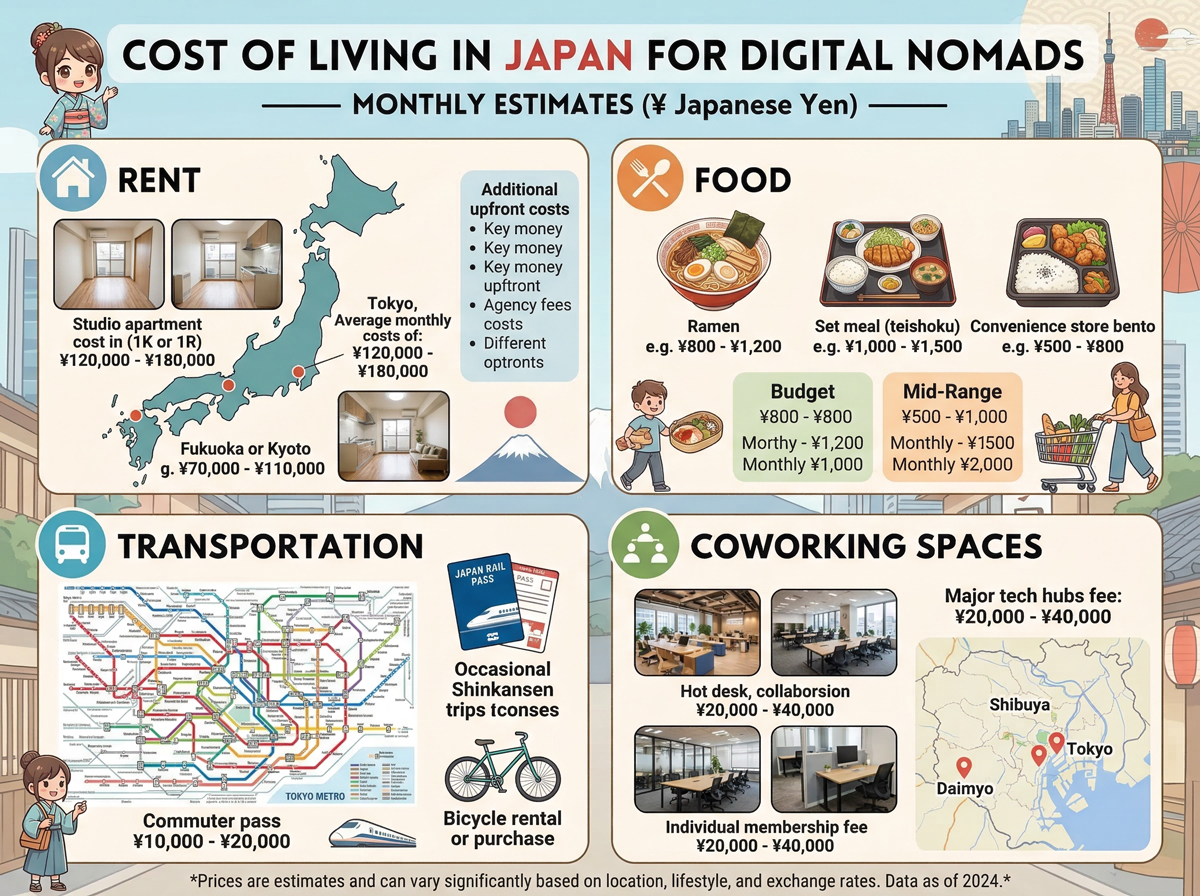
Housing: Usually Your Largest Line Item
Share houses and guest-focused monthly rooms
Share houses (private room, shared common space) often land around ¥60,000 – ¥120,000 depending on city center distance and building age. They can reduce upfront friction versus classic leases—read rules on guest policy, quiet hours, and work calls.
Solo apartments
Small 1R / 1K units marketed to monthly or short‑term renters may run roughly ¥100,000 – ¥200,000+ in major metros—Tokyo central pushes the top of (and beyond) that band. Key money (deposit‑like fees) and cleaning / renewal charges appear in some contracts—read the fine print.
Serviced apartments and Airbnb-style stays
Nightly‑rate math hurts on long stays unless you negotiate monthly or pick serviced products aimed at 30+ nights. Budget ¥150,000 – ¥350,000+ for central Tokyo monthly equivalents in furnished setups—sometimes more in peak seasons.
Coliving
If you want community + furnished room, what is coliving in Japan? explains how products differ from random share houses. Price often bundles utilities and events—compare per‑night vs pure rent apples‑to‑apples.
Neighborhood choice: For Tokyo, start with where to live as a digital nomad; for short first stays, also see where to stay in Tokyo.
Food: Cook, Convenience, or Dining Out
On mobile, swipe the table horizontally.
| Pattern | Rough monthly range (JPY) | Notes |
|---|---|---|
| Mostly cook + supermarket | ~¥35,000 – ¥55,000 | Groceries plus occasional konbini meals |
| Mixed | ~¥55,000 – ¥85,000 | Lunch sets, ramen, bento, some home cooking |
| Eat out often | ~¥90,000+ | Izakaya, sushi, coffee shops add fast |
Reality check: Convenience store meals are cheap per calorie; specialty coffee and imported groceries are not. Depachika (department‑store basements) are tempting and add up.
Transportation: Trains, Passes, and Bullet Trips
Local commuting (if you live near your main café / coworking rhythm): ~¥8,000 – ¥18,000 for many nomads who mostly walk + train inside a metro area.
IC cards (e.g. Suica / PASMO) smooth small purchases too—see Welcome Suica for digital nomads.
Shinkansen weekends are not “commuting”—they are discretionary travel. A few round trips per month can add tens of thousands of yen quickly—budget them explicitly.
Internet, Mobile Data, and Coworking
Home fiber (if included in rent—great; if not): often ~¥4,000 – ¥7,000 as a standalone line in many listings—confirm.
Mobile / data: ~¥3,000 – ¥8,000 depending on data cap, eSIM vs physical SIM, and tethering habits.
Many nomads blend:
- Best unlimited Wi‑Fi for Japan (router / long‑stay packages)
- eSIM vs pocket Wi‑Fi
- Airalo review — Japan context if you prefer eSIM‑first
Coworking (optional): ~¥10,000 – ¥45,000+ / month depending on city and plan (fixed desk vs flex). Café work is possible but respect purchase norms and peak‑hour seating etiquette.
Utilities and “Small” Bills That Aren’t Zero
Even in furnished stays, you may see electricity spikes in summer AC and winter heating. Water / gas may be bundled or metered. Ask whether internet is included—it changes your true housing cost.
Insurance and Health
If you use Japan’s digital nomad visa, you need private coverage that matches MOFA’s conditions—not “whatever is cheapest on Google.” Compare plans in nomad insurance for Japan, then verify wording against your embassy checklist.
For shorter trips, travel medical may still be wise even when not legally mandated—treat it as risk management, not a checkbox afterthought.
City Snapshots
These overlap heavily with lifestyle—treat as planning anchors, not guarantees.
On mobile, swipe the table horizontally.
| City | Why costs move | Rough “comfortable” planning band (JPY / month) |
|---|---|---|
| Tokyo | Rent and centrality dominate; more premium everything | Often ~¥300,000 – ¥480,000+ depending on ward |
| Osaka | Cheaper than central Tokyo for many equivalents; strong food scene | Often ~¥240,000 – ¥380,000 |
| Fukuoka | Smaller, nomad‑friendly, lower rent pressure than Tokyo in many cases | Often ~¥200,000 – ¥330,000 |
| Kyoto | Tourism demand can squeeze short stays; culture‑heavy | Often ~¥230,000 – ¥360,000 |
Deeper comparisons: Best cities in Japan for digital nomads — and the hub Digital Nomad Japan — complete guide if you want a single map of the cluster.
Money Movement: FX, Cards, and Yen Spending
Most short‑ and mid‑term visitors do not behave like Japanese salary earners with a full local bank stack. Nomads often:
- Receive income abroad
- Convert at transparent rates where possible
- Spend in yen with cards or cash where still required
A practical walkthrough: Wise Card for digital nomads in Japan. Compare fees against your currencies—“no foreign transaction fee” marketing still hides FX spreads sometimes.
Costs People Underestimate
- Moving between apartments (cleaning, transport, new bedding)
- Peak season short‑term rent premiums
- Shinkansen + hotel weekends when you explore
- Cash pockets in rural trips (ATMs exist—still plan)
- Health incidents without a clear coverage story
Tips to Spend Less Without Ruining the Trip
- Live one or two stops outside the priciest micro‑locations if commute tolerance allows.
- Mix cook + konbini + local lunch sets instead of dinner‑out every night.
- Buy rail passes only when the math works—not automatically.
- Book coworking after you test cafés and your focus needs.
- Track yen weekly in a simple sheet—small leaks show up fast.
Example: “Comfortable Osaka” Monthly Sketch
Use this only as a spreadsheet starter—swap numbers for your rent class and habits.
On mobile, swipe the table horizontally.
| Line item | Example (JPY) |
|---|---|
| Housing (private room, monthly‑style contract, not ultra‑central) | ¥110,000 |
| Utilities (electricity / water / gas split or bundled) | ¥12,000 |
| Food (mixed cook + dining out) | ¥70,000 |
| Local transport (IC + occasional taxi) | ¥12,000 |
| Mobile + backup data (phone + pocket Wi‑Fi or eSIM) | ¥9,000 |
| Coworking flex (part‑time) | ¥18,000 |
| Insurance (private plan—verify visa wording if applicable) | ¥12,000 |
| Gym / hobbies | ¥8,000 |
| Domestic travel (weekend trips) | ¥35,000 |
| Buffer (household goods, replacements) | ¥16,000 |
| Approximate total | ~¥302,000 |
If you delete travel and downgrade housing, you slide toward the lean band; if you add central Tokyo rent and daily premium dining, you jump bands fast.
Taxes and Accounting
This is not tax advice. If you earn income while physically in Japan—or stay many months—you may trigger questions in Japan and/or your home country about tax residency and reporting. Budgeting for living costs is separate from compliance costs (accountant fees, filings). If your stay is long or your income is high, plan a conversation with a cross‑border tax adviser before you optimize café receipts only.
Your planning week: execution order
Remote workers lose the most time in the gap between "I researched Japan" and "I booked one base." Treat this page as a decision tool—not a bookmark graveyard. The goal is one completed action per week until arrival.
Monday — confirm your row
Pick the situation table row that matches your visa, budget, and trip length. If two rows feel equally true, choose the more conservative one: shorter stay, higher insurance proof, clearer connectivity. Write your row in one sentence at the top of your notes app.
Tuesday — kill parallel tabs
Shortlist two options maximum for whatever this article covers (stay, eSIM, policy, or money rail). Open official pricing or checkout pages—not ten comparison blogs. Parallel research without a decision date burns calendar time and peak-season inventory.
Wednesday — run the checklist
Work through the Japan Setup Checklist 2026 in order. Steps 1–3 (SIM, insurance, money) protect week one. Do not skip them because hotel photos are more fun to browse.
Thursday — validate connectivity
If client calls matter, confirm backup internet before you rely on hotel Wi-Fi alone. Read eSIM vs pocket WiFi and install or order before departure when possible.
Friday — book or buy one thing
Complete one non-refundable-safe action: hold a flexible stay, buy an eSIM test plan, or purchase insurance that matches your certificate needs. Momentum beats perfection.
Iron rule before you close this tab
Reading ten more guides without booking, insuring, or connecting is how remote workers lose peak inventory and client trust in the same month. Pick your row, run the checklist, and act this week.
Hub: Digital nomad in Japan — complete guide · Fit: Is Japan good for digital nomads? · Visa: Digital nomad visa Japan
Express lane | Next step
Shortest path before you land
SIM: Airalo Japan review · Insurance: SafetyWing guide · Money: Wise card for Japan
Then run the Japan Setup Checklist 2026 (10 steps).
Complete SIM and insurance before you optimize hotel amenities—arrival week is too late for preventable setup debt.
Works well
- Clear next step after one table row
- Links to deeper Japan DN guides
- Action-first structure for remote workers
Common failures
- Endless research without booking or setup
- Ignoring visa or insurance wording
- No backup internet before client calls
Connectivity note
Your internet plan is part of accommodation quality—not a separate decision. Use primary Wi-Fi, secondary eSIM/SIM, and one emergency workspace option.
On arrival day, tether once from your phone to confirm backup works before you need it for a client call.
Compare: eSIM vs pocket WiFi · best unlimited WiFi
Pre-arrival checklist
City & band
You picked a city (Tokyo / Osaka / Fukuoka / Kyoto / other) and a target band (Lean / Comfortable / Spacious) that match your work and lifestyle.
Housing class
You decided between share house, monthly 1R/1K, serviced apartment, or coliving—and checked deposits, key money, cleaning, and renewal fees in the actual contract.
Connectivity stack
You shortlisted home Wi‑Fi vs pocket Wi‑Fi vs eSIM, and verified network labels for latency‑sensitive work (calls, VPN, sync).
Insurance line
For long stays under the digital nomad visa, your private plan wording matches MOFA conditions. For short trips, travel medical is treated as risk management, not an afterthought.
FX & spending stack
You planned how income arrives, how it converts to yen (transparent rate vs hidden spread), and which card/IC combination handles daily spend.
Travel buffer
Shinkansen weekends, peak‑season lodging premiums, and household replacements are budgeted as separate lines—not absorbed into “food.”
\ Lock a base that matches your budget row /
※Rates and cancellation rules are shown on Agoda at checkout.
First week after arrival
Stabilize connectivity and routine before you expand sightseeing.
Day 1
Internet test, desk setup, route mapping.
Day 2
First deep-work block + backup location test.
Day 3
Lock morning and evening routines.
Day 4–5
Normalize output; protect delivery windows.
Day 6–7
Explore locally without breaking schedule.
Why this works
One clear decision path beats ten parallel tabs. Act this week on the row that matches you—that is the operating rule.
Memo
Visa: digital nomad visa Japan · Setup: Digital Nomad Setup Japan · Hub: Complete Japan guide
Related articles
-

-
Where to Live in Tokyo as a Digital Nomad (2026) — Neighborhoods, Rent & Tradeoffs
\ Shortlist two Tokyo neighborhoods—then search / Search Tokyo stays on Agoda ※Rates and cancellatio ...
続きを見る

-
-
Best Cities in Japan for Digital Nomads【2026】Top Places to Live & Work
\ Pick a city row—then search stays / Search stays on Agoda ※Rates and cancellation rules are shown ...
続きを見る

-
-
Digital Nomad in Japan: The Complete Guide for Foreign Visitors (Stay, Budget, Wi-Fi, and Booking Smart)
\ Compare work-ready stays in Japan / Search stays on Agoda ※Rates, availability, and cancellation r ...
続きを見る


https://wanderwork.jp/nomad-finance/wise-card-digital-nomads-japan/
https://wanderwork.jp/workation-city-guide/digital-nomad-setup-japan/
https://wanderwork.jp/workation-city-guide/is-japan-good-for-digital-nomads/
FAQ
Should I decide everything before booking?
No—lock the highest-risk items first (stay, connectivity, insurance), then refine with the setup checklist.
Where should I start if Japan is new to me?
Read Is Japan good for digital nomads?, then follow the express lane above.
Article summary
- Pick your situation row first—then act this week
- Layer internet: Wi-Fi + eSIM backup
- Run the Japan setup checklist before non-refundable bookings
Block 90 minutes this week to confirm your row, run the checklist, and complete one high-leverage action.

Once your yen budget band is clear, secure one listing that protects work quality—not just nightly rate.
\ Book a base that fits your real monthly burn /
※Rates and cancellation rules are shown on Agoda at checkout.
※This article is general information for foreign visitors planning remote work in Japan. It does not guarantee booking outcomes, visa status, or internet performance. Confirm listing details, cancellation terms, and official requirements before you pay. Affiliate links may earn commission at no extra cost to you.