What you'll learn
- Usually fits best: Remote workers who want furnished setup, lower move-in friction, and optional social access without signing a heavy traditional lease.
- Common confusion: Treating "coliving" as guaranteed quality. In practice, each building's Wi-Fi, quiet rules, and room layout matter more than the label.
- Practical decision lens: Score each property for workability, privacy, and contract flexibility before comparing vibe or design photos.
- Usually poor fit if: You need guaranteed silence every day, dislike shared-space rules, or want full control that a standard apartment provides.
Key points
Two actions this week: ① Pick your situation row ② Complete the next step before you open another guide. Parallel research without action burns calendar time.
\ Compare coliving vs hotel-base options /
※Rates and cancellation rules are shown on Agoda at checkout.
Best choice by situation — 3 branches only
On mobile, swipe the table horizontally.
| Your situation | Conclusion | Next step |
|---|---|---|
| Want built-in community | Coliving candidate | Validate internet first |
| Need quiet solo work | Hotel / serviced apt | Agoda shortlist |
| Under 14 days | Hotel base | Complete guide |
Pick the row that matches you—then act this week.
Stop parallel-comparing ten options. Pick your row, then complete the next step this week.
10-second gate: Can you execute the next step with your current visa, budget, and connectivity plan? If not, fix that first.
What Is Coliving in Japan? Share House, Community, and Remote Work (2026 Guide)
Who this is for: You are considering your first longer stay in a Japanese city and keep seeing the word coliving next to furnished rooms, shared lounges, and "international community" photos. You need a clear definition, an honest comparison to familiar options, and a way to judge whether coliving fits your work style and budget.
This guide is written for one reader: a remote worker or freelancer who needs reliable daily work conditions, not only a stylish bed.
What "coliving" means
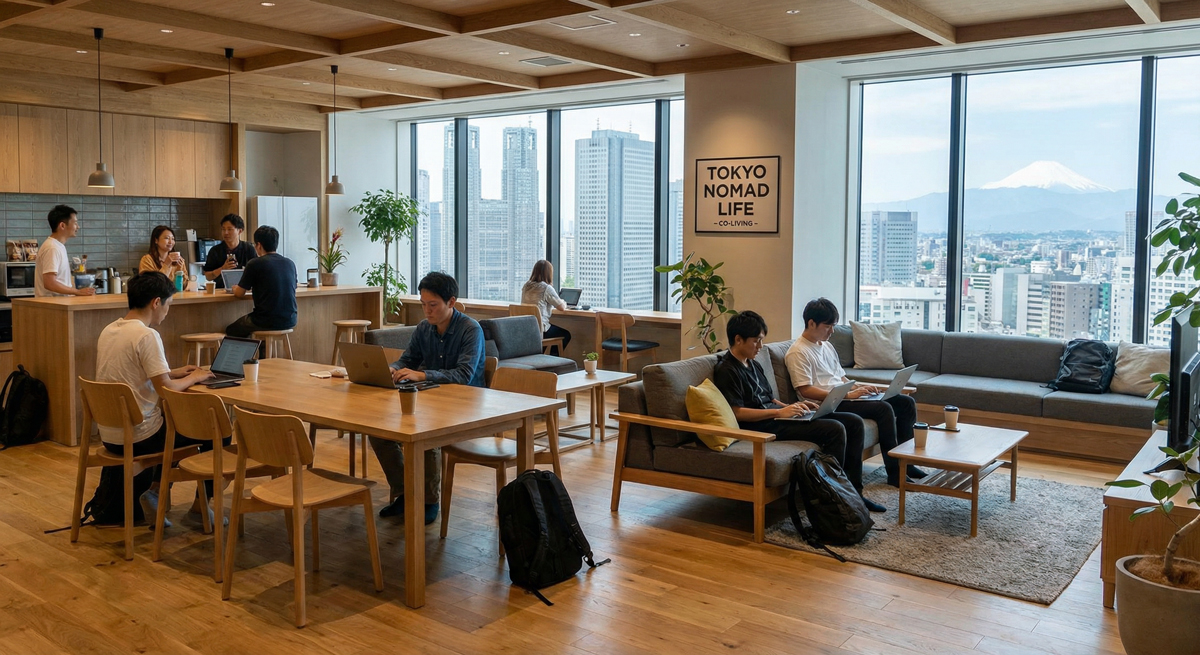
Coliving is a housing format that bundles private sleeping space with shared living infrastructure - kitchens, lounges, sometimes coworking-style desks - and often emphasizes community programming or at least a social layer between residents. In many properties, the operator also handles furniture, utilities, and internet as a package, which reduces the administrative load you would carry in a standard lease.
Coliving is not automatically:
- a hotel (length of stay and house rules differ),
- a party hostel (though some brands lean social - always read rules),
- or a guaranteed productivity paradise (Wi-Fi quality and noise vary by building).
Think of it as housing plus operations: someone designed the building or floor plan, set expectations for shared space, and tries to keep the experience repeatable for people who move often.
Coliving vs share house: a practical distinction
In Japan, people often use "share house" loosely. In marketing, coliving frequently signals a more managed experience: clearer branding, more English-friendly onboarding, and more intentional shared space design. That is a tendency, not a law - some share houses are polished, and some coliving brands stay minimal.
| Lens | Typical share house | Coliving (often) |
|---|---|---|
| Primary promise | Affordable private room in a shared property | Room plus shared lifestyle infrastructure and community layer |
| Operator role | Varies; can be light-touch | Often stronger: onboarding, events, standardized amenities |
| International readiness | Varies widely by property | Often marketed explicitly to global residents |
| Work suitability | Depends on house rules and room size | Depends on quiet zones, desk availability, and Wi-Fi - verify |
If you only keep one line from this table: your specific room and building matter more than the English label on the website.
Why coliving grew: three structural pressures
1) Urban housing cost and friction
In major global cities, traditional leases can demand heavy upfront costs and furniture purchases. Coliving operators often compete on lower move-in friction: a suitcase-first move-in can be realistic when the room is furnished and bills are bundled. That can matter for remote workers who do not want to buy appliances for a six-month chapter.
2) Social isolation in dense cities
You can feel alone in a crowd. Coliving does not solve social isolation by slogan, but it can reduce the activation energy required to meet people - if you want that. If you do not want social overlap, coliving can be the wrong tool; privacy varies by layout and house culture.
3) Remote work and location flexibility
When your income is not tied to a commute, housing becomes a workflow decision: can you take calls, upload files, and sleep well? Coliving properties sometimes advertise work-friendly amenities, but treat internet performance and noise as testable claims, similar to choosing a short-term rental.
For Japan-specific stay legality orientation (not legal advice), start here: Digital Nomad Visa Japan.
Coliving around the world
Many nomad-friendly cities developed coliving-style options early, often where international remote workers cluster. Names like Bali, Lisbon, and Barcelona appear frequently because supply and community events are common there.
Japan's market is different: contracts, language support, and building norms vary, and global branding may be stronger in central Tokyo than in smaller towns. That does not mean coliving cannot work outside Tokyo. It means your due-diligence checklist should stay local: commute, noise, winter insulation, and whether the operator's rules match your routine.
If you are comparing cities inside Japan for a medium-term base, see: Best Cities in Japan for Digital Nomads.
Coliving in Japan: what you actually get
Japanese coliving and modern share-house products frequently advertise:
- furnished private rooms,
- shared kitchens and lounges,
- internet included (still verify upload speed if you work online),
- scheduled common-area cleaning (confirm scope),
- international residents in properties aimed at global audiences.
What you should not assume:
- soundproof walls,
- unlimited perfect silence,
- or a dedicated private office unless the listing explicitly shows it.
For neighborhood choice and commute realism in Tokyo, pair this with: Tokyo Digital Nomad: Where to Live.
Benefits that are real
Lower-friction move-in
Traditional rental paths in Japan can involve high upfront costs. Coliving-style operators may reduce that pain for shorter horizons. Compare total monthly cost, including management fees, utilities, and renewal rules - not only headline rent.
For broader budget context: Cost of Living in Japan for Digital Nomads.
Furniture and basics included
If you dislike buying appliances for a temporary chapter, furnished formats can be rational even when monthly price is not the lowest on paper.
Community access
Some residents want introductions and shared meals, others want minimal interaction. If you need deep focus, prioritize properties with clear quiet rules, private room layout, and realistic work corners, or plan coworking membership as your real office.
Tradeoffs and risks to name honestly
- Privacy: shared walls and shared kitchens mean sound travels; house culture matters.
- Wi-Fi: internet included is not a substitute for testing upload speed during peak hours.
- Rules: guest policies, quiet hours, and cleaning expectations can feel strict - read before paying.
- Fit: if you dislike community expectations, a standard apartment may reduce social overhead.
For money movement and cards while setting up life admin: WISE Card for Digital Nomads in Japan.
If you want the full arrival stack in order (connectivity, banking, insurance, transit, stay): Digital Nomad Setup Japan: Complete Checklist.
Who coliving suits
Often a strong match if:
- you want a furnished, shorter-horizon setup without buying furniture,
- you value meeting people without building a social life from zero,
- you can tolerate shared-space norms in exchange for convenience.
Think twice if:
- you need guaranteed silence for daily calls and cannot tolerate variability,
- you dislike house rules or shared kitchen schedules,
- you are price-sensitive but unwilling to accept communal tradeoffs - sometimes a small apartment wins on control.
How to start in Japan: evaluate operators like a remote worker
Use this scorecard before you romanticize listing photos:
- Work test: ask about upload speeds, ethernet options, and whether residents run video calls daily.
- Noise test: read recent reviews mentioning thin walls, parties, or weak window insulation.
- Commute test: map train lines and grocery runs, not only cafe aesthetics.
- Contract test: understand cancellation, renewal, and what happens if work plans shift.
- Social test: decide whether you want events or quiet cohabitation.
A major Japanese option to compare listings: Oak House
One practical starting point in Japan is browsing large furnished share-house and coliving-style inventory with clear listing pages. Oak House is among the better-known operators domestically and often lists properties with international residents and English-friendly browsing flows.
If you want to compare rooms, areas, and move-in conditions in one place, start here:
Browse Oak House listings and current availability (Japan)
Treat any operator as a candidate, not a guaranteed personality match: visit if possible, read house rules carefully, and confirm the work realities you care about.
Bottom line
Coliving is best understood as managed shared housing with a community layer - sometimes excellent for remote workers, sometimes the wrong tool if you need maximum control and silence. In Japan, the winning move is to compare operators and specific buildings with the same skepticism you would apply to a work trip hotel: verify Wi-Fi, verify rules, verify commute, then decide.
Your planning week: execution order
Remote workers lose the most time in the gap between "I researched Japan" and "I booked one base." Treat this page as a decision tool—not a bookmark graveyard. The goal is one completed action per week until arrival.
Monday — confirm your row
Pick the situation table row that matches your visa, budget, and trip length. If two rows feel equally true, choose the more conservative one: shorter stay, higher insurance proof, clearer connectivity. Write your row in one sentence at the top of your notes app.
Tuesday — kill parallel tabs
Shortlist two options maximum for whatever this article covers (stay, eSIM, policy, or money rail). Open official pricing or checkout pages—not ten comparison blogs. Parallel research without a decision date burns calendar time and peak-season inventory.
Wednesday — run the checklist
Work through the Japan Setup Checklist 2026 in order. Steps 1–3 (SIM, insurance, money) protect week one. Do not skip them because hotel photos are more fun to browse.
Thursday — validate connectivity
If client calls matter, confirm backup internet before you rely on hotel Wi-Fi alone. Read eSIM vs pocket WiFi and install or order before departure when possible.
Friday — book or buy one thing
Complete one non-refundable-safe action: hold a flexible stay, buy an eSIM test plan, or purchase insurance that matches your certificate needs. Momentum beats perfection.
Iron rule before you close this tab
Reading ten more guides without booking, insuring, or connecting is how remote workers lose peak inventory and client trust in the same month. Pick your row, run the checklist, and act this week.
Hub: Digital nomad in Japan — complete guide · Fit: Is Japan good for digital nomads? · Visa: Digital nomad visa Japan
Express lane | Next step
Shortest path before you land
SIM: Airalo Japan review · Insurance: SafetyWing guide · Money: Wise card for Japan
Then run the Japan Setup Checklist 2026 (10 steps).
Complete SIM and insurance before you optimize hotel amenities—arrival week is too late for preventable setup debt.
Works well
- Clear next step after one table row
- Links to deeper Japan DN guides
- Action-first structure for remote workers
Common failures
- Endless research without booking or setup
- Ignoring visa or insurance wording
- No backup internet before client calls
Connectivity note
Your internet plan is part of accommodation quality—not a separate decision. Use primary Wi-Fi, secondary eSIM/SIM, and one emergency workspace option.
On arrival day, tether once from your phone to confirm backup works before you need it for a client call.
Compare: eSIM vs pocket WiFi · best unlimited WiFi
Pre-arrival checklist
Work setup
Room and common areas can support your actual work hours, not only short browsing.
Noise profile
Recent reviews and house rules indicate acceptable quiet windows for your meetings and focus work.
Internet reality
Operator can clarify upload speed, network reliability at peak hours, and call-heavy resident use cases.
Contract terms
Cancellation, renewal, management fees, and utility scope are clear before signing.
Area fit
Commute to stations, groceries, and fallback coworking spots is practical for your weekly routine.
Social expectations
Event culture and community norms match your preference for interaction level.
Total monthly cost
You compared rent plus bundled fees against alternatives, not only headline room price.
\ Book a work-ready base if coliving waitlists /
※Rates and cancellation rules are shown on Agoda at checkout.
Why this works
One clear decision path beats ten parallel tabs. Act this week on the row that matches you—that is the operating rule.
Memo
Visa: digital nomad visa Japan · Setup: Digital Nomad Setup Japan · Hub: Complete Japan guide
Related articles
-

-
Digital Nomad in Japan: The Complete Guide for Foreign Visitors (Stay, Budget, Wi-Fi, and Booking Smart)
\ Compare work-ready stays in Japan / Search stays on Agoda ※Rates, availability, and cancellation r ...
続きを見る

-
-
Where to Live in Tokyo as a Digital Nomad (2026) — Neighborhoods, Rent & Tradeoffs
\ Shortlist two Tokyo neighborhoods—then search / Search Tokyo stays on Agoda ※Rates and cancellatio ...
続きを見る

-
-
Digital Nomad Setup Japan: The Complete Checklist (eSIM, Wi-Fi, Banking, Insurance, and Stay)
\ Run the checklist—then book your base / Read complete Japan guide ※Official visa and insurance rul ...
続きを見る


https://wanderwork.jp/workation-city-guide/digital-nomad-setup-japan/
https://wanderwork.jp/workation-city-guide/tokyo-digital-nomad-where-to-live/
https://wanderwork.jp/workation-city-guide/digital-nomad-japan-complete-guide/
FAQ
Should I decide everything before booking?
No—lock the highest-risk items first (stay, connectivity, insurance), then refine with the setup checklist.
Where should I start if Japan is new to me?
Read Is Japan good for digital nomads?, then follow the express lane above.
Article summary
- Pick your situation row first—then act this week
- Layer internet: Wi-Fi + eSIM backup
- Run the Japan setup checklist before non-refundable bookings
Block 90 minutes this week to confirm your row, run the checklist, and complete one high-leverage action.
If coliving inventory is thin, secure a conventional base with desk and internet proof, then revisit share houses later.
\ Community is optional—work stability is not /
※Rates and cancellation rules are shown on Agoda at checkout.
※This article is general information for foreign visitors planning remote work in Japan. It does not guarantee booking outcomes, visa status, or internet performance. Confirm listing details, cancellation terms, and official requirements before you pay. Affiliate links may earn commission at no extra cost to you.