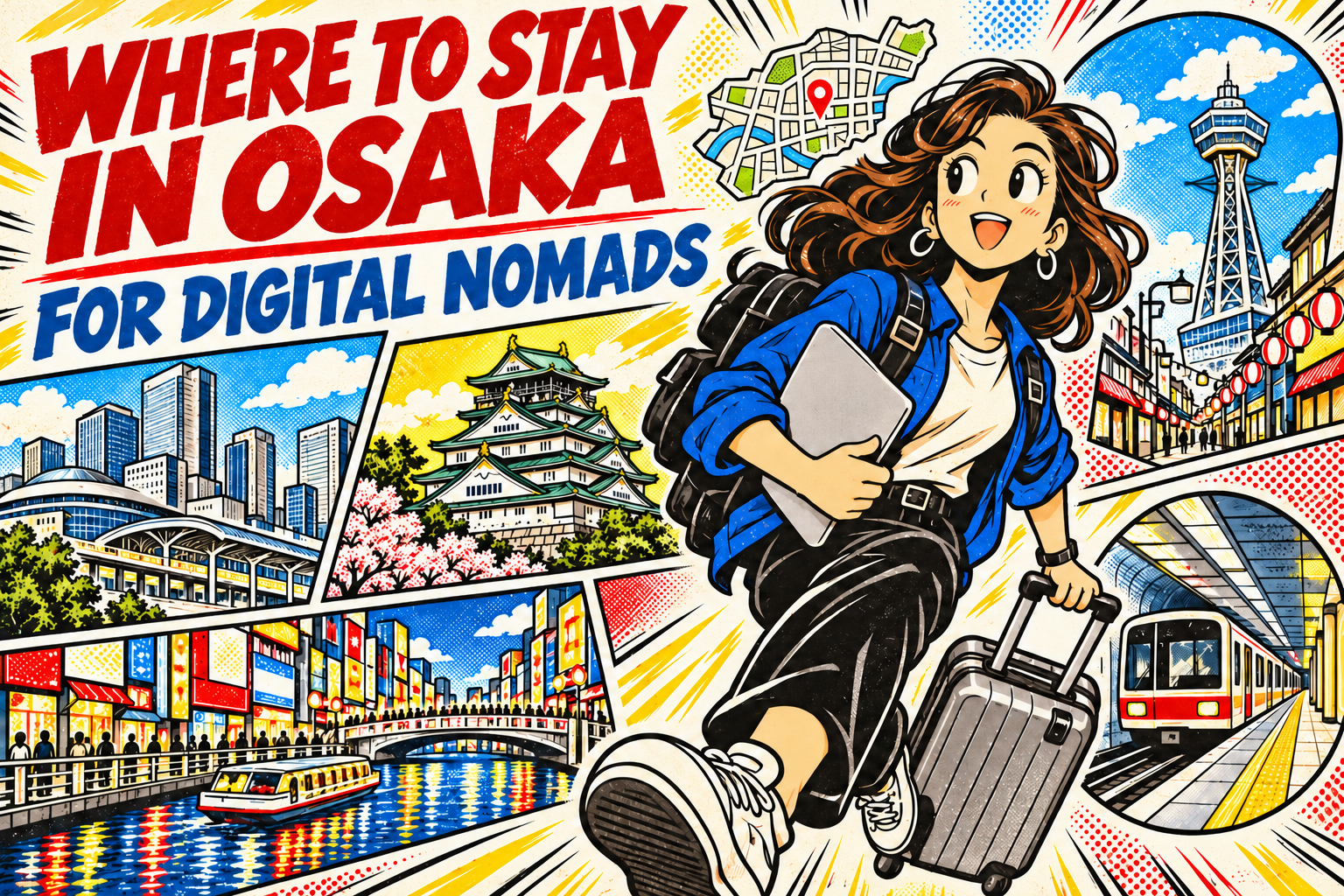

Quick answer: choose Umeda for maximum rail access, Namba for nightlife and Kansai Airport convenience, or Honmachi for the strongest work-first balance. Nakazakicho and Tenma add creative local texture; Fukushima and Nakatsu keep you near Umeda with a calmer home rhythm; Shin-Osaka is the Shinkansen tool; and Tennoji/Abeno is the first value scan. Osaka works best when your accommodation, coworking and most-used train line form one small operating zone.
Which Osaka area fits your week?
Maximum transport optionality: Umeda / Osaka Station — pay more to reduce transfers.
Food, nightlife and KIX access: Namba / Shinsaibashi — energetic, convenient and rarely quiet.
Work-first central base: Honmachi / Kitahama / Yodoyabashi — business rhythm between Kita and Minami.
Creative local routine: Nakazakicho / Tenma — smaller streets and more neighborhood texture.
Near Umeda, calmer at home: Fukushima / Nakatsu — central without sleeping inside the main hub.
Frequent Shinkansen trips: Shin-Osaka — functional rather than romantic.
Value and airport practicality: Tennoji / Abeno — strong south-city access at a lower planning band.

Why you can trust this guide
- Research basis: WANDERWORK planning ranges aligned with the Japan cost-of-living guide; district and work-rhythm positioning checked against Osaka's official area guide, Osaka Metro, KIX and current coworking operators
- Last checked: 2026-11-03
- Before you decide: Monthly ranges are planning anchors for furnished short stays, not ordinary residential rents or listing guarantees. Confirm the total price, internet, desk, noise, cancellation terms and legal stay conditions for your dates.
This guide answers one decision: where should a remote worker base themselves in Osaka? It is not a generic sightseeing list. The comparison starts with sleep, calls, coworking, airport and intercity travel, then treats food and nightlife as benefits rather than the operating system.
If you are still comparing Japanese cities, start with Best Cities in Japan for Digital Nomads. Use the Japan cost-of-living planner for the full monthly budget and the digital nomad visa guide before assuming your immigration status permits your planned remote work.
\ Choose the operating zone before the room /
Rates, taxes and cancellation rules are shown on Agoda at checkout.
Best choice by situation
| Your situation | Start with | Why |
|---|---|---|
| First Osaka stay | Umeda or Namba | Easy orientation and broad accommodation choice |
| Call-heavy workweek | Honmachi or Fukushima | Central access without full nightlife exposure |
| Frequent Kyoto/Kobe days | Umeda | Strong northbound rail connections |
| Frequent KIX trips | Namba or Tennoji | Direct airport-oriented rail options |
| Frequent Shinkansen trips | Shin-Osaka | Remove the transfer before an early train |
| Lower-cost central routine | Tennoji or Nakatsu | Trade prestige for a more forgiving housing scan |
| Nightlife is the point | Namba / Shinsaibashi | Food and entertainment remain walkable late |
Pick one row, then compare two areas maximum. Osaka is easier than Tokyo to cross, but a bad daily transfer still becomes expensive in attention.
Osaka geography in two minutes: Kita, Minami and the Midosuji spine
Osaka's official tourism guide divides the central city into recognizable zones. Kita centers on Umeda and Osaka Station: offices, major shopping complexes and regional rail connections. Minami centers on Namba and Shinsaibashi: food, entertainment, fashion and late-night energy. Tennoji/Abeno anchors the south, while the Osaka Castle and waterfront zones solve different lifestyle needs.
For a digital nomad, the practical shortcut is the Osaka Metro Midosuji Line. It links Shin-Osaka, Umeda, Yodoyabashi, Honmachi, Shinsaibashi, Namba and Tennoji. That single north-south spine makes a one-line home-to-coworking setup possible. Check the official Osaka Metro route map before paying for a famous district that requires two daily transfers.
The 7 best Osaka areas for digital nomads at a glance
These are furnished solo-stay planning anchors, not market averages. Utilities, Wi-Fi, cleaning, deposits, season and cancellation terms can move the final total substantially.
| Area | Best for | Rough monthly (JPY) | Noise | English support |
|---|---|---|---|---|
| Umeda / Osaka Station | Rail reach, business and first-time convenience | ¥180,000–¥350,000+ | Medium–high | High |
| Namba / Shinsaibashi | Nightlife, food and KIX-oriented access | ¥160,000–¥320,000+ | High | High |
| Honmachi / Kitahama / Yodoyabashi | Coworking and work-first centrality | ¥150,000–¥300,000 | Low–medium | Medium–high |
| Nakazakicho / Tenma | Creative local rhythm and neighborhood texture | ¥130,000–¥260,000 | Medium | Medium |
| Fukushima / Nakatsu | Near-Umeda convenience with calmer nights | ¥140,000–¥280,000 | Low–medium | Medium |
| Shin-Osaka | Shinkansen frequency and functional stays | ¥130,000–¥250,000 | Medium | Medium |
| Tennoji / Abeno | Value, south-city access and KIX practicality | ¥120,000–¥240,000 | Medium–high | Medium |
Do not compare the room price alone. A cheaper unit can lose its advantage through paid coworking, weak desk ergonomics, extra transfers, laundry fees or unreliable in-room internet.
1. Umeda and Osaka Station — best for maximum optionality
Choose Umeda when your calendar changes quickly. The Osaka Station area connects JR routes, Hankyu, Hanshin and multiple subway stations, making Kyoto, Kobe and many city districts easier to reach. The official Osaka guide describes Kita as Osaka's evolving gateway of offices, retail and large-scale complexes.
Why it works
- Strong regional and city transport options
- Broad hotel and serviced-stay inventory
- Business services, shopping and food in one zone
- Easier English-first arrival than quieter residential districts
Trade-offs
- Large station complexes take time to learn
- Station-front pricing can erase Osaka's cost advantage
- Some blocks stay busy late, and construction or rail noise varies by building
Best for a first stay, meeting-heavy weeks and frequent Kyoto or Kobe trips. If sleep matters more than instant access, scan Fukushima or Nakatsu before paying the Umeda premium.
2. Namba and Shinsaibashi — best for nightlife and KIX access
Choose Namba when you want food, social energy and airport-oriented convenience. The official guide positions Minami as the energetic intersection of tradition, fashion and entertainment. Nankai trains connect Kansai Airport with Nankai Namba, which can simplify arrival and departure days; always confirm the current route and timetable on the KIX access page.
Why it works
- Walkable access to Dotonbori, Shinsaibashi and dense dining
- Broad accommodation inventory across several price levels
- Useful KIX orientation through Nankai Namba
- Strong English visibility in visitor-facing businesses
Trade-offs
- Street noise, nightlife and crowds can conflict with early calls
- A Dotonbori address is not automatically a productive home base
- Weekend pricing and foot traffic can change the feel of the same block
Best for social weeks and short stays. For deep work, stay on a side street or move one or two subway stops away instead of sleeping beside the brightest landmark.
3. Honmachi, Kitahama and Yodoyabashi — best work-first base
Honmachi sits between Umeda and Namba on the Midosuji Line. That position makes it the strongest default for a nomad who needs centrality without living inside either entertainment pole. Kitahama and Yodoyabashi extend the same business-district logic toward offices, riverside walks and a calmer evening rhythm.
This is also Osaka's clearest coworking cluster for international remote workers. The DECK advertises drop-in, weekly and monthly use, soundproof booths and monitors near Sakaisuji-Hommachi. Osakan Space offers drop-in use and a traveler-focused Digital Nomad Plan near Honmachi, with English support and meeting booths. Prices, opening hours and payment rules can change, so verify the official pages before choosing housing around a workspace.
Why it works
- Direct Midosuji access to Umeda, Namba and Shin-Osaka
- Strong coworking choice and call infrastructure
- Quieter evenings than Namba in many blocks
- Central without depending on a giant terminal station
Trade-offs
- Less spontaneous nightlife at the door
- Some office streets feel quiet on Sundays
- Business hotels may offer weak desks despite the district's professional image
Best for two-week to three-month stays built around serious work.
4. Nakazakicho and Tenma — best creative local rhythm
Nakazakicho and Tenma suit people who want smaller streets, independent businesses and a more local daily loop while staying close to Umeda. The appeal is texture: cafés, neighborhood restaurants and an easier shift from workday to evening without entering a full entertainment district.
Why it works
- Close to Umeda without living inside the terminal complex
- More neighborhood character than a pure office district
- Good fit for writers, designers and asynchronous teams
Trade-offs
- Older buildings need closer checks for insulation, stairs and desk space
- Café atmosphere does not guarantee call-friendly work
- Popular streets can still become busy on weekends
Best for independent workers who want community texture and can verify the room itself carefully.
5. Fukushima and Nakatsu — best near-Umeda compromise
Fukushima and Nakatsu let you keep Umeda within easy reach while creating more distance from the main station's crowds. Fukushima has a strong dining identity and JR access; Nakatsu offers a quieter northern edge near the Midosuji Line.
Why it works
- Easy access to Umeda meetings and transport
- More residential sleep potential than station-front Umeda
- Restaurants and daily services without full Namba intensity
Trade-offs
- Convenience varies sharply by the exact station and side of the tracks
- English support is less uniform than in the biggest visitor hubs
- Some attractive listings still require a walk that feels longer with luggage
Best for call-heavy workers who want central access but do not need entertainment outside the door.
6. Shin-Osaka — best for frequent Shinkansen travel
Shin-Osaka is a tool, not a lifestyle fantasy. Stay here when early Shinkansen departures, repeated Tokyo/Hiroshima travel or short project visits dominate your calendar. The Midosuji Line also links the station directly with Umeda, Honmachi, Namba and Tennoji.
Why it works
- Remove one transfer before intercity rail days
- Often more functional accommodation than entertainment-heavy districts
- Direct Midosuji access through central Osaka
Trade-offs
- Less neighborhood atmosphere than Tenma, Fukushima or Namba
- Dining and social choice can feel thin outside the station zone
- Airport access still requires route planning; Shin-Osaka is not KIX
Best for frequent intercity work. If you take only one Shinkansen during a month, do not sacrifice your entire daily environment to save one transfer.
7. Tennoji and Abeno — best value and south-city access
Tennoji/Abeno combines major transport, shopping and south-city access with a lower planning band than Umeda or the most central Minami blocks. The official Osaka guide describes the area as a mix of modern skyline and older city scenery.
Why it works
- Useful access to the JR Kansai Airport Rapid direction
- Major station services without Umeda-level complexity
- Strong first scan for a lower-cost furnished base
- Easy access to Namba and central Osaka
Trade-offs
- Noise and street atmosphere vary block by block
- Some south-side listings trade price for a longer walk or older building
- Do not book from district reputation alone; inspect the exact route at night
Best for budget-aware stays, southern Kansai movement and people who want a large hub without paying the Umeda premium.
Where should you avoid staying in Osaka?
Avoid a mismatched block, not a neighborhood based on internet folklore. Osaka's practical problems are usually noise, last-train access, luggage friction, weak desks and the wrong work environment—not a clean citywide red line.
Reject a listing when:
- recent reviews repeatedly mention street, rail or nightlife noise;
- the route home requires multiple late-night transfers;
- the room cannot confirm a usable desk and stable in-room internet;
- you need calls but the only backup is a quiet café;
- the all-in price hides cleaning, utilities, deposits or inflexible cancellation;
- the walk feels isolated or inconvenient when you test it after dark on a map and in recent reviews.
For light sleepers, the immediate Dotonbori nightlife zone is a poor default even if Namba is otherwise the right district. For frequent meetings in Umeda, a cheap far-south room can become expensive in time. The correct question is not "Is this area bad?" but "Does this block support my actual week?"
Cheapest practical areas for a digital nomad
Start with Tennoji/Abeno, Shin-Osaka, Nakatsu and Tenma, then compare one or two stations outside the famous hubs. These areas can offer a lower furnished-stay entry point while retaining useful transport.
Use this order:
- Set an all-in housing ceiling in yen.
- Add the coworking or phone-booth cost your job actually requires.
- Price your most frequent weekly route, not a sightseeing itinerary.
- Reject a low price if the desk, internet or sleep evidence is weak.
The cost-of-living guide uses ¥240,000–¥380,000 per month as a comfortable Osaka planning band across housing, food, transport, workspace and connectivity. Your housing line should leave room for the rest of that system.
Umeda or Namba for a first stay?
Choose Umeda when regional rail, business access, Kyoto/Kobe trips and a calmer professional rhythm matter most. Choose Namba when KIX-oriented access, food, nightlife and a visitor-friendly first week matter most.
Choose neither automatically. Honmachi is often the stronger one-month decision because it sits between both and concentrates coworking. The first-time tourist answer and the first-time remote-worker answer are not always the same.
Airport and intercity travel should influence your base
| Your repeated trip | Area to test first |
|---|---|
| Kansai Airport via Nankai | Namba |
| Kansai Airport via JR direction | Tennoji, then Umeda depending service |
| Kyoto or Kobe | Umeda / Osaka Station |
| Tokyo, Hiroshima or Fukuoka by Shinkansen | Shin-Osaka or Midosuji-line base |
| Central Osaka coworking | Honmachi / Sakaisuji-Hommachi |
KIX's official access guidance identifies Nankai Namba, JR routes and Umeda-bound buses among the city connections. Service patterns change, so check the official airport access page for your terminal, arrival time and luggage before booking around a single route assumption.
Coworking, calls and café etiquette
Use accommodation Wi-Fi for ordinary focus work only after you have evidence it is reliable. Use a coworking space or reservable booth for client calls, workshops and confidential work. A café with Wi-Fi is not permission to run a long video meeting.
Before paying for a workspace, confirm:
- drop-in availability versus membership-only access;
- staffed hours versus member access hours;
- phone booth rules and reservation fees;
- monitor availability;
- English onboarding and accepted payment methods;
- Sunday and national-holiday closures.
Honmachi is the best place to begin this search because The DECK and Osakan Space both publish options aimed at short-term international users. Umeda adds a larger business ecosystem, while Namba is stronger for visitor convenience than for a guaranteed quiet call setup.
Osaka's digital-nomad community in November 2026
As checked on November 3, 2026, the independent OSAKA Digital Nomads Workation site lists a two-week program running November 1–14, 2026, with coworking, community activities and city tours. The organizer presents it as a 50–100-person international community program and currently points late interest to a waitlist.
Treat organizer claims about relative cost, internet speed and community size as promotional information, not citywide guarantees. The useful signal is narrower: Osaka now has an explicitly international nomad event and English-language coworking operators. The 2026 dates will expire, so check the official site for a future program instead of assuming this cohort repeats.
Match the housing type to your stay length
3–7 days: remove setup friction
Use a flexible hotel or serviced stay near Umeda, Namba or Tennoji. Prioritise station access, luggage handling and a cancellation option over apartment-style savings.
1–4 weeks: test your operating zone
Compare apartment hotels, weekly products and private rooms on total cost, desk evidence, laundry and cleaning. Honmachi becomes more attractive because daily work matters more than sightseeing proximity.
1–3 months: optimise the routine
Furnished monthly apartments, share houses and coliving become more relevant. Check deposits, exit fees, utilities, address-registration limitations, guest rules and whether the contract matches your immigration status.
Up to 6 months: buy sustainability
The longer you stay, the more groceries, sleep, laundry, backup internet and a repeatable workspace matter. A cheaper residential edge can outperform a famous central address if the commute remains simple.
A one-week decision workflow
Monday — choose your non-negotiable
Write one sentence: "I need quiet calls," "I need KIX access," or "I need Kyoto twice a week."
Tuesday — shortlist two areas
Choose one obvious hub and one work-first alternative. Example: Namba plus Honmachi, or Umeda plus Fukushima.
Wednesday — test the routes
Use current transit tools for your airport, coworking and one repeated weekly destination. Count transfers and the last practical train.
Thursday — verify the room
Request desk photos, in-room Wi-Fi evidence, laundry details and a complete fee breakdown. Read recent noise reviews.
Friday — book one flexible base
Book the first week or a cancellation-friendly stay. Do not lock three months because one neighborhood photo looked right.
Pre-booking checklist
Housing and work
- The total price includes utilities, cleaning and mandatory fees
- The room has a usable desk and chair, not only a low table
- In-room internet evidence is recent, with backup mobile data planned
- Recent reviews do not repeatedly report noise that conflicts with your schedule
- A call-friendly coworking space or booth is reachable without two transfers
Transport and legal stay
- Your repeated airport or rail route works with luggage and your arrival time
- You checked the exact station exit and walking route, not only the district name
- The cancellation policy still works if the room fails your first-week test
- Your visa or status of residence fits your planned activities and duration
Where to stay in Osaka: FAQ
What is the best area to stay in Osaka for a digital nomad?
Honmachi is the strongest work-first default because it sits between Umeda and Namba on central subway lines and has coworking options aimed at international remote workers. Choose Umeda for maximum transport reach or Namba for nightlife and KIX-oriented convenience.
Where should a first-time visitor stay in Osaka?
Umeda is easier for regional rail and business access; Namba is easier for food, entertainment and many visitor services. For a one-month remote-work stay, add Honmachi to the comparison before deciding.
Is Umeda or Namba better?
Umeda is better for Kyoto/Kobe travel, meetings and broad rail access. Namba is better for nightlife, walkable entertainment and Nankai access toward Kansai Airport. Light sleepers and call-heavy workers should avoid the loudest station-front blocks in either district.
What is the cheapest convenient area in Osaka?
Tennoji/Abeno, Shin-Osaka, Nakatsu and Tenma are the first practical scans. Compare the all-in furnished cost and workspace needs; the lowest room price can lose once you add coworking and transfers.
Where should I avoid staying in Osaka?
Avoid any block with repeated noise complaints, weak late-night transport, poor desk evidence or a route that fights your weekly schedule. Do not label an entire neighborhood unsafe from one anecdote. Test the exact street, building and station exit.
Where should I stay for easy Kansai Airport access?
Namba is the clearest starting point for Nankai services, while Tennoji connects with the JR Kansai Airport Rapid direction. Umeda also has JR and bus options. Confirm the current service for your terminal and arrival time on the official KIX site.
Is Osaka or Kyoto better for a remote-work base?
Osaka is usually the easier operating base for coworking, late food, transport choice and a larger urban routine. Kyoto suits a culture-first, quieter stay. If you need both, Umeda can simplify repeated Kyoto trips while keeping Osaka's work infrastructure.
Can I work from cafés in Osaka?
Some cafés have Wi-Fi and power, but policies and crowding vary. Keep calls short and quiet unless the venue explicitly supports them. Use coworking or a booth for client meetings and confidential work.
Article summary
- Umeda maximises transport; Namba maximises food, nightlife and KIX-oriented convenience.
- Honmachi is the strongest work-first default and Osaka's clearest international coworking cluster.
- Tennoji, Shin-Osaka, Nakatsu and Tenma are practical lower-cost scans.
- Avoid a mismatched block—not an entire district based on online folklore.
- Price the complete system: housing, coworking, transfers, internet backup and sleep.
- Verify legal stay conditions separately; a good neighborhood does not create work permission.
Choose the area that supports your most repeated week, then book one flexible base. Osaka's advantage is not that every district is cheap or quiet; it is that you can build a high-functioning urban routine without paying for Tokyo-scale optionality you may never use.
\ Two candidate areas are enough /
Confirm total price, workspace, Wi-Fi evidence and cancellation terms before paying.