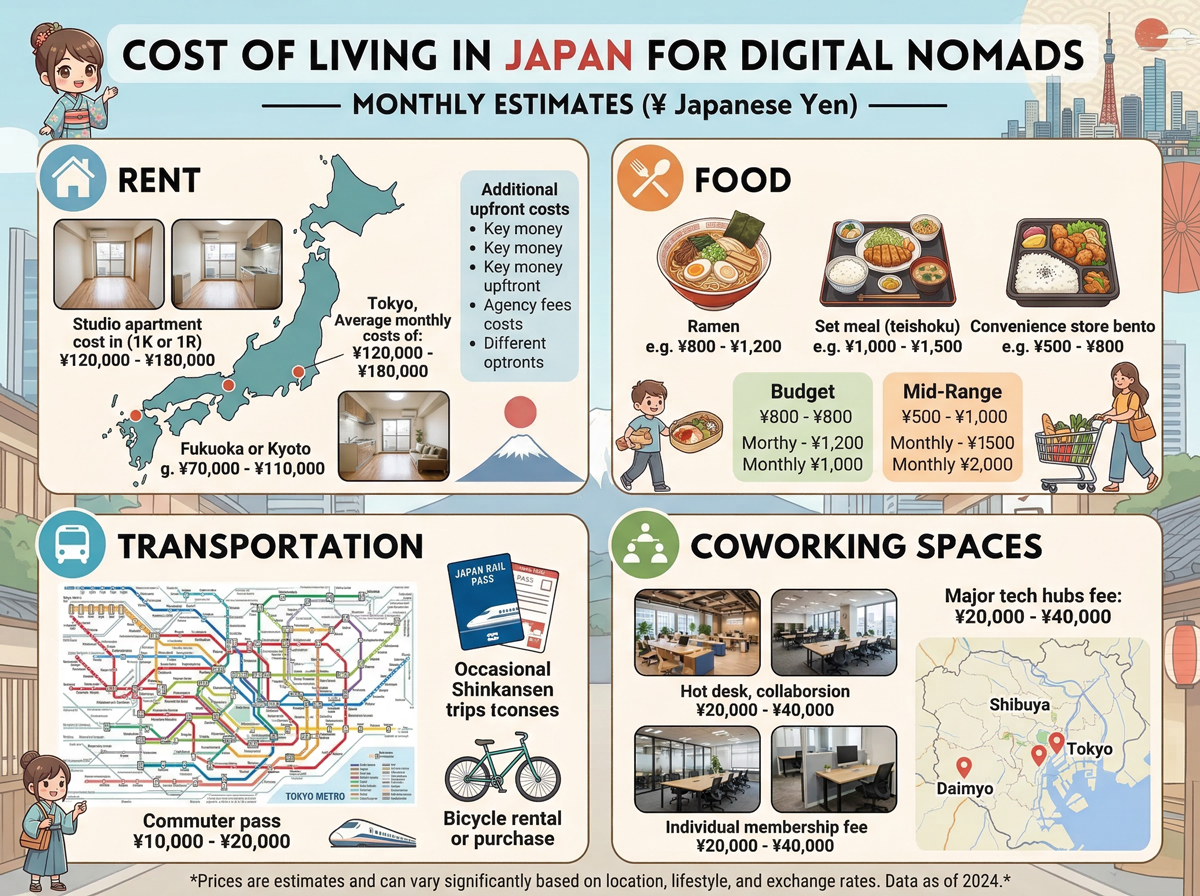

Quick answer: most solo digital nomads should budget roughly ¥180,000–¥400,000 per month in Japan — about ¥1.08M–¥2.4M for a full six-month stay — depending on city, housing class, and how often you eat out and travel. That is usually more than an ordinary Japanese resident pays, because nomads lean on furnished apartments, coworking, travel eSIMs, international insurance, and foreign payment services instead of a standard long lease and local salary account.
How much do you need? The three planning bands
Lean — ¥180,000–¥260,000/month (≈ ¥1.08M–¥1.56M for 6 months): share house or small room outside the priciest wards, mostly cooking, local trains, minimal coworking.
Comfortable — ¥260,000–¥400,000/month (≈ ¥1.56M–¥2.4M for 6 months): private room or compact solo apartment, regular dining out, coworking some days, occasional domestic trips.
Premium — ¥400,000+/month (≈ ¥2.4M+ for 6 months): central or larger floor plan, frequent dining and travel, premium coworking, more taxis.

Why you can trust this guide
- Research basis: WANDERWORK planning estimates triangulated from current 2026 market sources; visa facts from MOFA/JNTO official pages
- Last checked: 2026-09-20
- Before you decide: Prices are illustrative estimates, not guarantees. Visa rules are official — confirm the latest figures with MOFA and your embassy before you fly.
This is a budget planner, not a generic price list. It gives yen-first ranges (USD only as a rough lens — rates move), a 1/3/6-month total, a Tokyo vs Osaka vs Fukuoka comparison, the hidden costs generic calculators miss, and the money/connectivity/security lines nomads actually pay. For visa eligibility and the income threshold, see Digital Nomad Visa Japan; for "is Japan worth it for me?", read Is Japan good for digital nomads?. This budget is one piece of the bigger picture — for the end-to-end overview that ties visa, money, connectivity and housing together, start with the Complete Guide to being a digital nomad in Japan.
Best choice by situation
| Your situation | Conclusion | Next step |
|---|---|---|
| Central Tokyo, work-first | Plan the Premium band | Where to live in Tokyo |
| Osaka, cost-balanced | Comfortable band | Best cities |
| Fukuoka, lower burn | Lean–Comfortable | Compare stays below |
Pick the row that matches you, then model the total this week rather than perfecting a spreadsheet you never book from.
How much does it cost to live in Japan as a digital nomad?
For many remote workers, monthly spend lands in a mid band — cheaper than Switzerland or London for some lifestyles, pricier than Bangkok or Bali for comparable comfort. Your city, housing type, and how often you eat out move the needle more than anything else.
Two rules before the tables:
- Ranges, not promises. Costs swing with season, neighborhood, floor area, and how you book (walk-in vs platform fees). Treat every figure as a planning estimate to verify for your dates.
- Budget in yen first. Japan prices are quoted in JPY; converting daily helps you feel local prices faster than mentally converting everything to USD. At ~¥150 per $1, ¥300,000 ≈ $2,000 — but always check the rate you actually get.
Why digital nomad costs run higher than "average" Japan costs
Most "cost of living in Japan" numbers describe a resident: an unfurnished apartment on a two-year lease, a local bank account, and a domestic phone plan. A digital nomad staying one to six months usually cannot — or does not want to — sign that lease, so the real bill includes premiums a resident never pays:
- Furnished / serviced / monthly apartments instead of an empty unit on a long lease.
- Short-term and arrival accommodation (hotels for the first nights).
- Coworking rather than a free company office.
- Travel eSIMs and pocket Wi-Fi for reliable, latency-safe connectivity.
- International medical insurance (a requirement on the digital nomad visa).
- Foreign payment and FX — every conversion and card spread is a real line item.
That is why a nomad's "comfortable" month can sit ¥50,000–¥150,000 above a resident's equivalent. This guide prices the nomad version.
1-, 3- and 6-month budget planner
Multiply your monthly band by your stay length. These totals use the same band assumptions throughout the article.
| Lifestyle | 1 month | 3 months | 6 months |
|---|---|---|---|
| Lean | ¥180,000–¥260,000 | ¥540,000–¥780,000 | ¥1.08M–¥1.56M |
| Comfortable | ¥260,000–¥400,000 | ¥780,000–¥1.20M | ¥1.56M–¥2.40M |
| Premium | ¥400,000+ | ¥1.20M+ | ¥2.40M+ |
Length of stay changes the math: a six-month stay spreads insurance, a router, and furnishings over more days, so per-month averages can beat four short visits that repeat move-in costs. Neither is automatically cheaper — model both if you are choosing one long stay vs several short ones.
A real digital nomad monthly budget (line by line)
Build your number from categories, not a single guess. The label shows whether a cost is fixed, variable, optional, or arrival-only.
| Category | Typical monthly range (JPY) | Type |
|---|---|---|
| Furnished accommodation | ¥60,000–¥350,000+ | Fixed |
| Utilities (electric / gas / water) | ¥8,000–¥20,000 | Variable |
| Groceries / cooking | ¥35,000–¥55,000 | Variable |
| Restaurants / dining out | ¥20,000–¥90,000+ | Variable |
| Local transport (IC card) | ¥8,000–¥18,000 | Variable |
| Coworking | ¥10,000–¥45,000+ | Optional |
| Mobile data / eSIM | ¥3,000–¥8,000 | Fixed |
| Home internet (if not bundled) | ¥4,000–¥7,000 | Fixed |
| VPN / security | ¥500–¥1,500 | Optional |
| Insurance (private / visa-compliant) | ¥8,000–¥20,000 | Fixed |
| Entertainment / social | ¥10,000–¥40,000 | Variable |
| FX / international transfer costs | ¥2,000–¥10,000+ | Variable |
| Domestic travel (Shinkansen weekends) | ¥0–¥40,000 | Optional |
| Setup & miscellaneous | ¥15,000–¥40,000 | Arrival-only |
Do not add every high end together and panic — most people are lean on some lines and premium on one or two. The bands above already blend these into realistic totals.
Accommodation: your largest and most decision-heavy cost
Housing decides your band. Crucially, do not budget with ordinary Japanese long-term rent — a nomad on a 1–6 month stay rarely gets a resident's standard lease, guarantor, and unfurnished price.
| Housing type | Rough monthly (JPY) | Best for |
|---|---|---|
| Share house / guest-focused room | ¥60,000–¥120,000 | Lean budgets, easy move-in, community |
| Monthly 1R / 1K apartment | ¥100,000–¥200,000+ | Privacy, 1–6 month stays (watch key money/cleaning) |
| Serviced apartment / Airbnb-style | ¥150,000–¥350,000+ | Convenience, central, short lead time |
| Long-stay hotel | ¥180,000–¥400,000+ | Zero setup, arrival weeks, flexibility |
A practical strategy: arrive into a hotel or short-term stay for the first few nights, then move to a monthly apartment, serviced apartment, or share house once you have seen the neighborhood and tested the commute. Book flexible, cancellation-friendly options until your plans (and, if relevant, your visa) are confirmed. For community-plus-furnished, what coliving means in Japan explains how those products differ; for Tokyo specifically, read where to live in Tokyo.
\ Model rent, then hold a flexible base /
Rates, availability and cancellation rules are shown on Agoda at checkout.
Tokyo vs Osaka vs Fukuoka: what you get for the extra cost
These are comfortable-band planning anchors, not guarantees. The point is not "Tokyo expensive, Fukuoka cheap" — it is what you receive for the difference.
| City | Comfortable band / month | ≈ 6-month total | What you get |
|---|---|---|---|
| Tokyo | ¥300,000–¥480,000 | ¥1.80M–¥2.88M | Maximum choice, business & networking, deepest coworking and transit |
| Osaka | ¥240,000–¥380,000 | ¥1.44M–¥2.28M | Urban lifestyle and food scene at a lower rent than central Tokyo |
| Fukuoka | ¥200,000–¥330,000 | ¥1.20M–¥1.98M | Lower cost, compact city, fast-growing nomad community |
Treat the "what you get" column as editorial positioning, not fact: Tokyo buys optionality and networking; Osaka buys a cost-balanced big-city rhythm; Fukuoka buys lower burn and a walkable base. Your coworking commute, noise tolerance, and Japanese ability should drive the pick — not photos.
How much could you save by choosing Fukuoka over Tokyo for six months? Comparing the comfortable bands, Fukuoka runs roughly ¥100,000–¥150,000 less per month, which is about ¥600,000–¥900,000 saved over a six-month stay — often the single biggest lever in your whole budget. See best cities in Japan for digital nomads for the full comparison.
How much money do you need for six months in Japan?
This is the number most visa applicants actually need. Japan's official Digital Nomad Visa grants a single stay of up to six months and is not renewable (a Specified visa: Designated activities status per MOFA/JNTO — confirm current rules with MOFA and your embassy). So the six-month column is your real planning total:
- Lean: ¥1.08M–¥1.56M
- Comfortable: ¥1.56M–¥2.40M
- Premium: ¥2.40M+
Budget this on top of the visa's own costs (fee, six months of qualifying insurance, translations) covered in the visa guide — this article stays focused on living costs, not eligibility. If your income clears the visa's threshold, funding a comfortable six months is usually the easier test; the harder one is booking flexible housing and matching your insurance wording before you fly.
Hidden costs generic calculators miss
Numbeo-style summaries price a resident's steady month. Nomads pay extras a calculator rarely shows:
- Furnished-rental premium — the same room costs more furnished and short-term than on a resident lease.
- Deposits, key money, cleaning and renewal fees — some monthly contracts still charge them.
- Accommodation / lodging tax — some cities and hotels add a per-night tax.
- Airport transport — the first ride in (train or limousine bus) before you have an IC card set up.
- Intercity travel — Shinkansen weekends are discretionary, not commuting; budget them separately.
- eSIM / connectivity and a backup line — reliable data is a work cost, not a nicety.
- International medical insurance — required on the visa, and larger than a domestic plan.
- FX spreads, ATM fees and card conversion — a few percent, quietly, on every transfer and spend.
- Arrival setup purchases — bedding, kitchen basics, adapters, a router.
Naming these as separate lines — not absorbing them into "food" — is what turns a nice-looking average into a budget that survives contact with arrival week.
Money and FX: the line most people forget
Your real cost is not only rent + food + transport — it is rent + food + transport + FX. Most short- and mid-term visitors do not run a full Japanese salary-account stack; they receive income abroad, convert to yen, and spend by card or cash. Every conversion has a spread, and "no foreign transaction fee" marketing can still hide a weak rate.
A practical setup is to convert at transparent rates and spend in yen with a card that shows the real cost. See Wise Card for digital nomads in Japan and, for gate/transit tap-to-pay, Wise + Apple Pay at Japan train gates.
\ Convert income to yen without hidden spreads /
Availability, exchange cost and card features depend on your account and route — check the live quote.
Connectivity: a work cost, not a luxury
Reliable internet is part of your accommodation quality, not a separate afterthought. Plan a primary connection plus a backup on a different path so one router failure never kills a client call.
- Arrival: a travel eSIM gets you online at the airport — see our Airalo review (Japan context).
- Longer stay: compare a router or long-stay package in best unlimited Wi-Fi for Japan and the tradeoffs in eSIM vs pocket Wi-Fi.
- Backup: keep the eSIM as a fallback even after you settle a main line.
An eSIM is the fastest arrival option, not automatically the cheapest for a full six months — the honest path is arrive on eSIM → evaluate a long-term line → keep the eSIM as backup.
\ For eligible new users /
Confirm device compatibility, data allowance and current checkout terms before purchase.
If Saily's security tools are useful to you, compare its live Japan plan against the same budget line. Do not pay for overlapping eSIMs unless one is a deliberate backup.
\ Budget the eSIM before checkout /
New users can enter WANDERWORK for 15% off. Confirm device support, data, validity and hotspot terms before purchase.
Security on public Wi-Fi (café, coworking, hotel)
Much of a nomad's work happens on shared networks — café, coworking, hotel, and airport Wi-Fi. A VPN is a low, fixed monthly cost (often ¥500–¥1,500) that protects logins and client data on those networks. Budget it as a small security line rather than skipping it.
\ Protect logins on shared networks /
Confirm the current plan, term and price on the official site before you subscribe.
Example: a "Comfortable Osaka" monthly sketch
Use this as a spreadsheet starter — swap numbers for your rent class and habits.
| Line item | Example (JPY) |
|---|---|
| Housing (private room, monthly-style, not ultra-central) | ¥110,000 |
| Utilities | ¥12,000 |
| Food (mixed cook + dining out) | ¥70,000 |
| Local transport (IC + occasional taxi) | ¥12,000 |
| Mobile + backup data | ¥9,000 |
| Coworking (part-time) | ¥18,000 |
| Insurance (private; verify visa wording if applicable) | ¥12,000 |
| VPN / security | ¥1,000 |
| Gym / hobbies | ¥8,000 |
| Domestic travel (weekend trips) | ¥35,000 |
| Buffer (household goods, replacements) | ¥15,000 |
| Approximate total | ~¥302,000 |
Delete travel and downgrade housing and you slide toward the lean band; add central Tokyo rent and daily premium dining and you jump a band fast.
Taxes and accounting (not tax advice)
If you earn income while physically in Japan — or stay many months — you may raise questions in Japan and/or your home country about tax residency and reporting. Living costs are separate from compliance costs (accountant fees, filings). If your stay is long or your income is high, plan a conversation with a cross-border tax adviser before you optimize café receipts.
Final recommendation: turn the number into a booking
Once your yen band is clear, secure one base that protects work quality — not just the lowest nightly rate. The order that saves the most money and stress:
- Pick a city and band (Fukuoka/Osaka lean-comfortable, or Tokyo premium).
- Compute your 1/3/6-month total from the planner above.
- Hold a flexible, cancellation-friendly stay for arrival; commit to a monthly place after you see the neighborhood.
- Set up money (Wise), connectivity (eSIM + backup), and insurance before you fly — arrival week is too late.
- If you use the six-month visa, confirm the visa requirements and insurance wording in parallel.
Your planning week: one action at a time
- Monday — pick your row
- Choose the city and band that match your trip length and work needs; write it in one sentence.
- Tuesday — kill parallel tabs
- Shortlist two stays maximum; open real checkout pages, not ten comparison blogs.
- Wednesday — run the checklist
- Work through the Japan Setup Checklist 2026 so steps 1 to 3 (SIM, insurance, money) protect week one.
- Thursday — validate connectivity
- Confirm a backup line before you rely on hotel Wi-Fi.
- Friday — book or buy one thing
- Hold a flexible stay, buy an eSIM test plan, or set up your Wise account.
Pre-arrival budget checklist
Budget and city
- You picked a city (Tokyo / Osaka / Fukuoka / other) and a band (Lean / Comfortable / Premium) that match your work and lifestyle
- You calculated your 1/3/6-month total from the same band assumptions
Housing and money
- You chose a housing class (share house, monthly 1R/1K, serviced apartment, hotel) and checked deposits, key money, cleaning and renewal fees in the actual contract
- You planned how income arrives, how it converts to yen (transparent rate vs hidden spread), and which card/IC combination handles daily spend
Connectivity and cover
- You shortlisted home Wi-Fi vs pocket Wi-Fi vs eSIM and a backup line for calls
- For a visa stay, your private insurance wording matches MOFA conditions; for short trips, travel medical is treated as risk management
Cost of living in Japan for digital nomads: FAQ
How much does a digital nomad need per month in Japan?
Plan for roughly ¥180,000–¥400,000 a month solo, depending on city and lifestyle: Lean ¥180,000–¥260,000, Comfortable ¥260,000–¥400,000, Premium ¥400,000+. Central Tokyo pushes you up a band; Osaka and Fukuoka soften the bill for similar comfort.
Is ¥200,000 per month enough to live in Japan?
It can be — that sits in the Lean band and works best in Osaka, Fukuoka, or outer Tokyo with a share house or small monthly room, mostly cooking, and light coworking. In central Tokyo, or with a serviced apartment and frequent dining out, ¥200,000 will feel tight.
How much money do I need for six months in Japan?
About ¥1.08M–¥1.56M (Lean), ¥1.56M–¥2.4M (Comfortable), or ¥2.4M+ (Premium). This is the planning total most Digital Nomad Visa users need, on top of the visa fee and six months of qualifying insurance.
Is Tokyo much more expensive than Osaka or Fukuoka?
Yes, mainly through rent and centrality. On the comfortable band, Tokyo runs about ¥100,000–¥150,000 more per month than Fukuoka — roughly ¥600,000–¥900,000 over six months. Osaka sits between the two.
What is the cheapest city in Japan for digital nomads?
Among the big three, Fukuoka is usually the lowest cost, with a compact, walkable base and a growing nomad community; Osaka is the mid option. The tradeoff is a smaller scene and less optionality than Tokyo.
How much does short-term accommodation cost in Japan?
Roughly: share house ¥60,000–¥120,000, monthly 1R/1K apartment ¥100,000–¥200,000+, serviced apartment or Airbnb-style ¥150,000–¥350,000+, and long-stay hotel ¥180,000–¥400,000+ per month — higher in central Tokyo and peak seasons.
Can digital nomads rent apartments in Japan?
Yes, but usually furnished monthly, serviced, or share-house products rather than a standard resident lease with a guarantor. Expect a furnished premium and shorter minimum terms — which is exactly why nomad housing costs more than "average Japanese rent."
What costs do digital nomads usually underestimate in Japan?
Furnished-rental premiums, deposits and cleaning fees, lodging tax, Shinkansen weekends, international insurance, and FX/ATM fees. Budget these as separate lines rather than absorbing them into food or rent.
Article summary
- Solo nomads land around ¥180,000–¥400,000/month; a six-month stay is roughly ¥1.08M–¥2.4M, above ordinary resident costs because of furnished housing, coworking, insurance and FX.
- City is the biggest lever: choosing Fukuoka over Tokyo can save ¥600,000–¥900,000 over six months.
- Set money, connectivity and insurance before you fly, then hold one flexible base that protects work quality.
Related articles
-

-
Digital Nomad in Japan: Complete Guide for Foreign Visitors
A digital nomad trip in Japan succeeds when your accommodation protects work quality—not when it win ...
続きを見る

-
-
Japan Digital Nomad Visa 2026: Requirements & How to Apply
The Japan Digital Nomad Visa is a six-month, non-renewable residence status for high-earning remote ...
続きを見る

-
-
Best Cities in Japan for Digital Nomads (2026): Top 6 Compared
Quick answer: for most remote workers the shortlist is Tokyo, Osaka or Fukuoka — Tokyo for maximum o ...
続きを見る

-
-
Is Japan Good for Digital Nomads? Pros, Cons & 2026 Verdict
Short answer: for many remote workers, yes — Japan can be an excellent base, but not for every budge ...
続きを見る

-
-
Wise Card in Japan for Digital Nomads (2026): Does It Work?
Short answer: yes — the Wise card works well in Japan as a spend-and-FX layer, but it is not a full ...
続きを見る